
7 RFP Software Platforms for GovCon Teams in September 2026

Akash Mandavilli
CEO and Co-Founder of GovEagle
About the author
Akash is a 2x founder with previous experience in AI from Meta and federal sales from IBM. Akash holds a dual-degree from Johns Hopkins University in Economics and Computer Science.
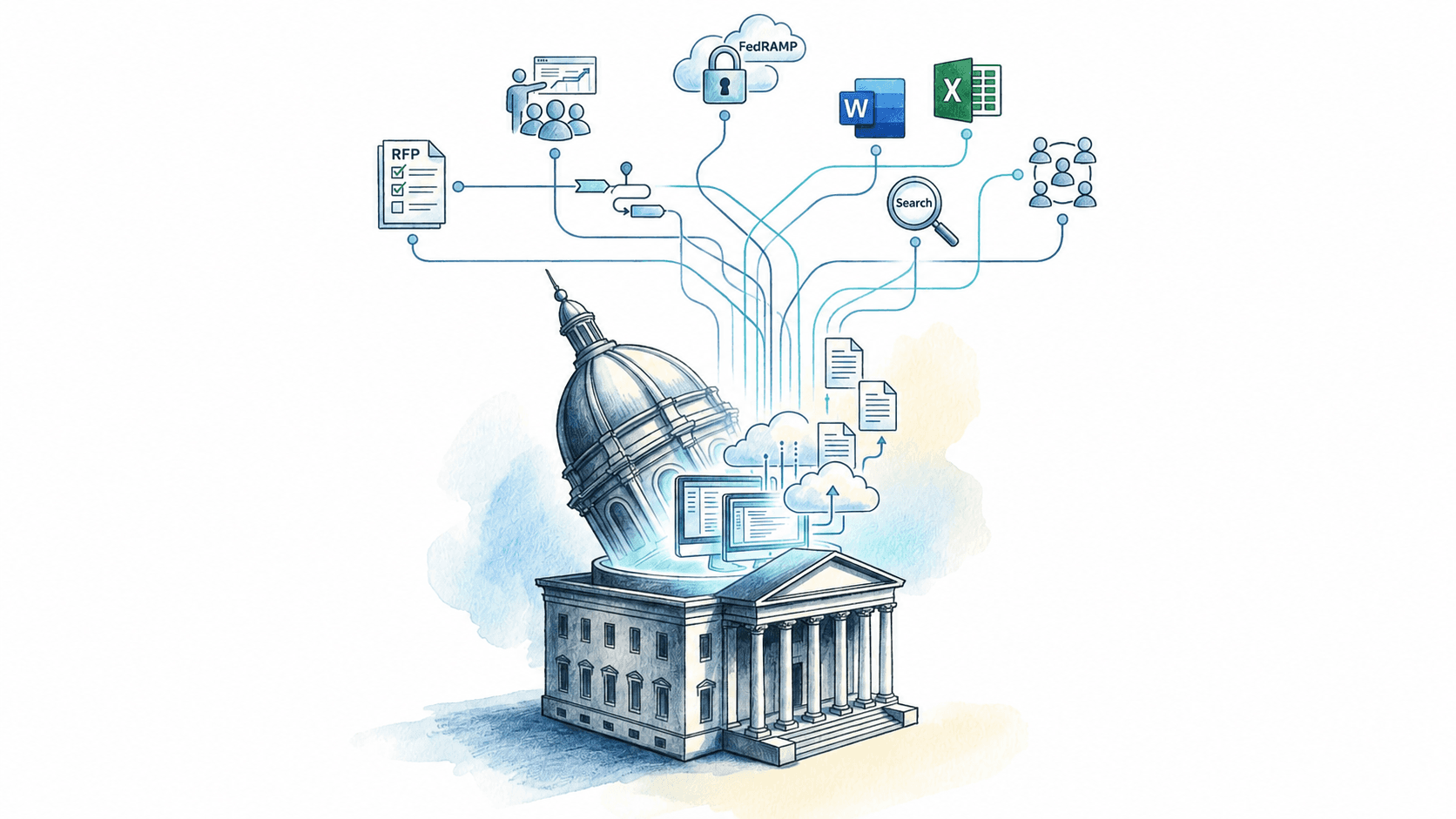
The difference between RFP software built for federal contractors and the generic alternatives shows up fast, usually around the time your proposal manager is manually cross-referencing Section L against Section M two days before submission. BD and proposal teams running concurrent federal pursuits need tools that fit how federal acquisition actually works. What follows is a breakdown of seven options, ranked against the criteria that matter most in a GovCon workflow.
TLDR:
- GovCon RFP software spans a wide range from opportunity discovery tools to full capture-to-submission workflows; fit depends on where your team's bottleneck actually sits.
- Tools built for general RFP response volume, like Loopio, often lack native Section L/M compliance mapping and CUI handling controls for federal pursuits.
- Post-draft analysis tools add value at Red Team but create a gap for teams that need to move from solicitation to first draft quickly.
- For teams handling CUI, security posture varies across the category; FedRAMP alignment and CMMC Level 2 support should be confirmed directly with each vendor.
- The top-ranked tool in this list covers the full capture-to-submission arc with Excel-native compliance matrix generation, Microsoft Word integration, and FedRAMP Moderate Equivalency security; one customer cut SME time on early-stage proposals by 80%.
What Is RFP Software for Government Contractors?
RFP software for government contractors manages the federal proposal lifecycle, from tracking solicitations on SAM.gov contract opportunities to organizing compliance matrices and coordinating writers across color team reviews. GovCon-specific software treats an RFP as a structured regulatory response, mapping every deliverable back to Section L and Section M criteria.
Best Overall RFP Software: GovEagle

What Sets GovEagle Apart for Federal Proposals
- The compliance matrix generates automatically from the solicitation, cross-referencing Section L against Section M, so proposal managers start from a structured baseline instead of spending the first day on manual extraction.
- Past performance, management approach, and technical approach sections draft from the content library, cutting SME dependence in early production. Precise Software cut SME time on early-stage proposals by 80%.
- Pipeline intelligence surfaces pre-solicitation signals so capture leads make bid/no-bid calls before a solicitation drops.
- Security runs on AWS GovCloud and Azure with self-hosted options, aligned with FedRAMP Moderate Equivalency, CMMC Level 2 alignment, and NIST 800-171 compliance for teams handling CUI.
GovEagle fits BD and proposal teams managing multiple active pursuits who need a capture-to-submission workflow. It is well-suited for:
- Mid-market to large contractors running concurrent proposals across multiple agencies, where compliance traceability and content reuse compound over time.
- Teams that need to free SMEs for review, not initial content generation.
- Organizations for which FedRAMP Moderate Equivalency and GCC-compatible deployments are security baselines, not preferences.
GovEagle is built for federal GovCon workflows. Contractors whose pursuits fall outside FAR-governed solicitations will find the compliance architecture more than they need; for majority-federal teams, that specificity is the point.
GovSignals
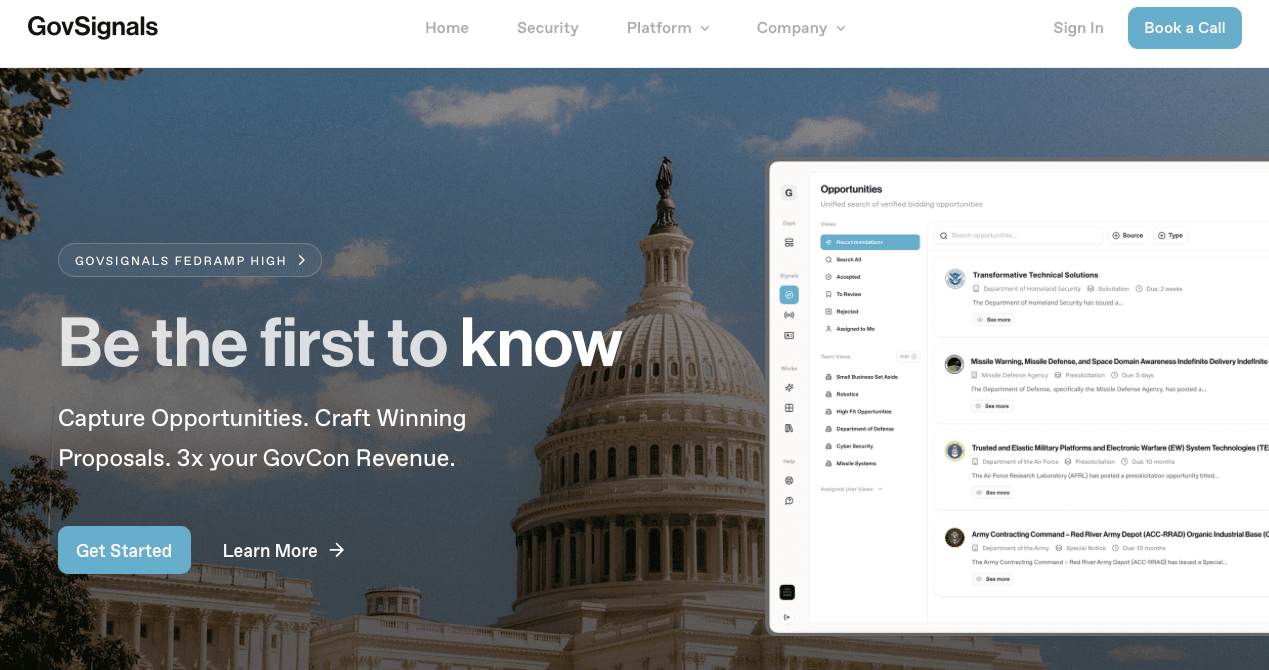
GovSignals is a federal business intelligence and proposal support tool covering opportunity tracking, pipeline management, and AI-assisted drafting. It performs well in the pre-solicitation phase, with strong agency spend data and incumbent tracking. The gap shows up in proposal production: drafting requires manual handoffs between the intelligence layer and the writing environment, adding friction for teams working capture through submission in a single toolset.
- Federal data coverage is a differentiator for teams mapping agency relationships and spend history before a solicitation drops.
- Proposal drafting is complementary to the research workflow, not a standalone end-to-end submission capability.
- Per GovSignals' public compliance page, the tool lists a FedRAMP High-authorized posture, IL5, SOC 2 Type II, and ITAR; buyers should still verify current authorization details directly before handling CUI.
VisibleThread
VisibleThread positions itself as a document analysis tool, with federal proposal teams being one of its target use cases. Its core workflow sits in post-draft analysis: readability scoring, compliance gap detection, and passive voice flagging after content has already been written.
Teams that need to move from RFP to first draft quickly will find VisibleThread's value concentrated at the review stage, not the creation stage.
AskSage
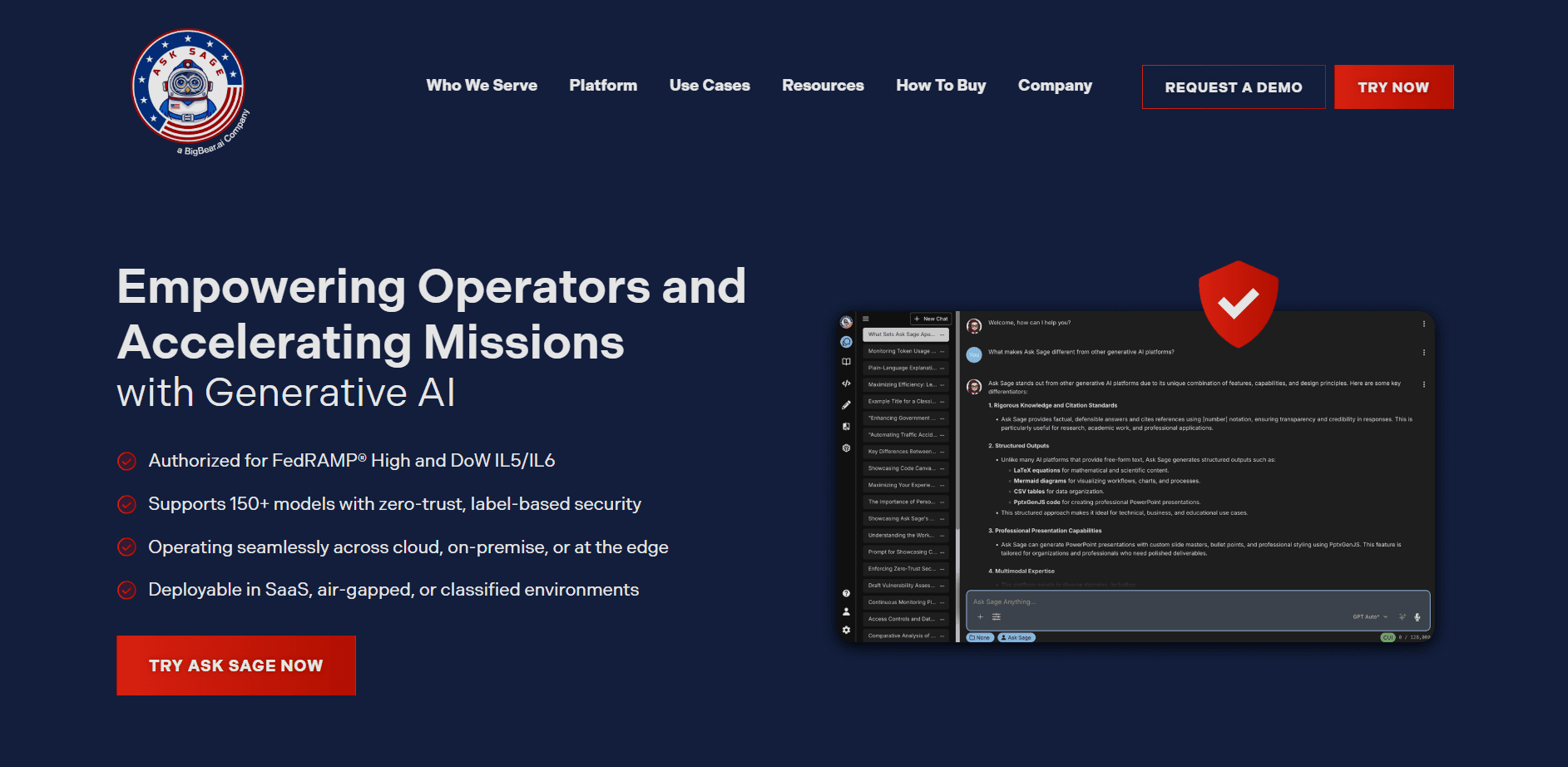
AskSage is a secure generative AI tool with FedRAMP High authorization and support for DoD IL5/IL6 environments. It has a documented path into classified networks, making it one of the few tools in this category that can operate in those environments. Teams can verify authorization status against the FedRAMP Marketplace. For proposal teams, AskSage functions as a general-purpose AI assistant: teams can query uploaded documents and draft sections, but the workflow requires manual orchestration without native federal proposal workflows such as Section L/M compliance matrix generation or direct Word/Excel proposal authoring. The strongest fit is teams operating under CUI handling requirements or on classified programs where commercial AI tools are off the table. The trade-off is feature depth: proposal managers end up building processes on top of a general AI layer, not working inside a tool designed around federal acquisition mechanics.
- Teams pursuing classified or high-sensitivity programs may find the security posture warrants the workflow overhead.
- General proposal use cases, particularly those requiring structured compliance tracking or color team coordination, typically call for a more purpose-built solution.
- Pricing is subscription-based with tiered access depending on classification level and deployment environment.
Get GovCon capture and proposal insights in your inbox.
Unanet ProposalAI
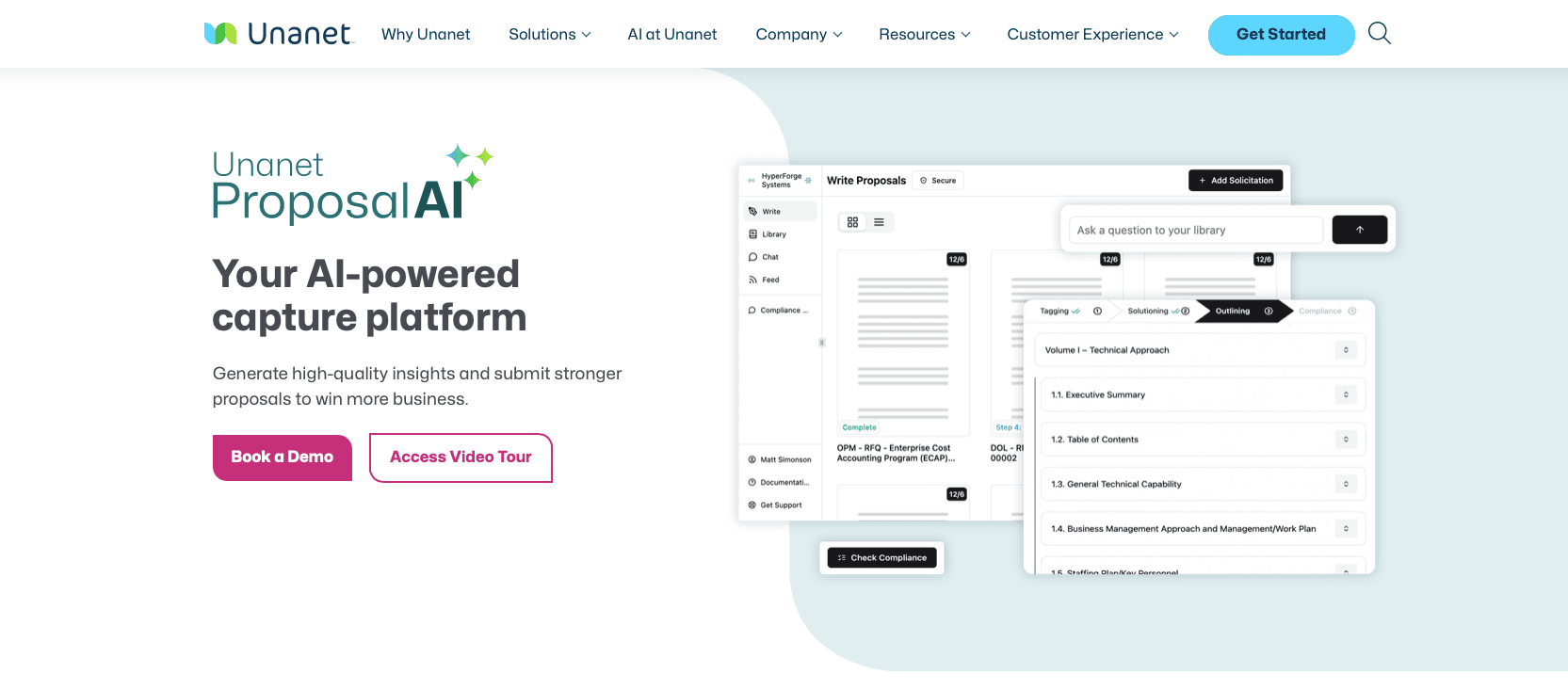
Unanet ProposalAI sits within the broader Unanet GovCon ERP suite, pulling from existing project and past-performance data to reduce manual context assembly, a core benefit of proposal automation at any lifecycle stage. For contractors already inside the Unanet ecosystem, the integration value is real. For those outside it, ProposalAI is bundled into a larger ERP investment, and the entry cost may outweigh the proposal-specific capabilities on offer.
pWin.ai
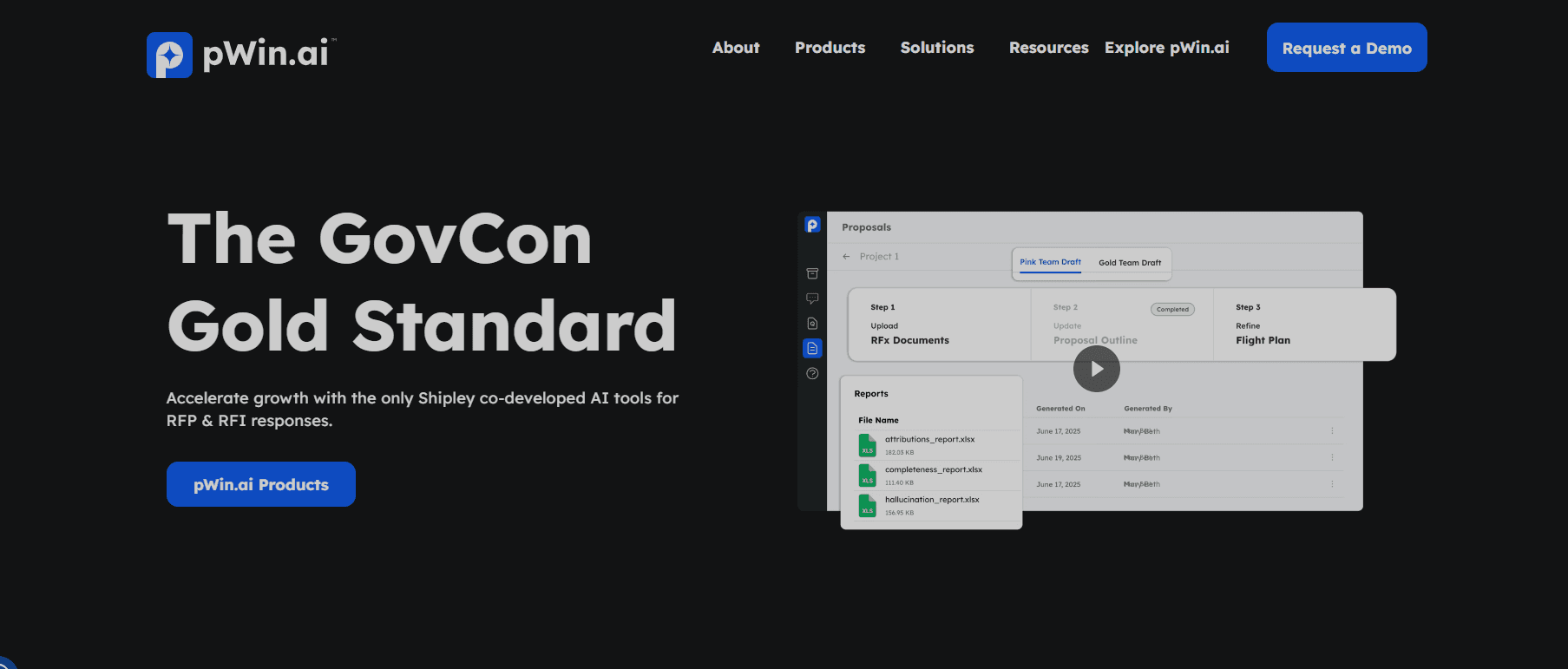
pWin.ai focuses on win probability modeling and capture analytics, built for BD teams that want quantitative scoring on pursuit decisions before committing proposal resources. Its strongest use is pre-RFP: incumbent analysis, competitive positioning scores, and bid/no-bid support.
The writing and compliance side is more limited. Teams using it for RFP response workflows often bridge gaps with separate document tools, adding handoff friction during color team reviews.
- Opportunity scoring pulls from public procurement data to estimate PWin based on incumbent relationships, past award patterns, and agency spend history.
- Capture workflow tracking lets teams log pre-RFP activities and monitor engagement milestones, though it stops short of compliance matrix generation and Section L/M mapping, or the AI for CMMC assessments that security-focused teams require.
Loopio
Loopio is a response management tool built around a centralized content library, commonly used for high-volume RFP responses across general and government markets. Teams can build out libraries of past-performance summaries and standard technical responses, but the federal-specific workflow layer shows friction. Section L/M compliance mapping, FAR-aligned response structuring, and CUI-handling controls are not native to the product.
- The content library works well for repeat-response scenarios but offers limited support for compliance matrices tied to specific solicitation requirements.
- Proposal drafting happens inside Loopio's own interface, which creates friction for teams anchored in Microsoft Word and Excel.
- Security documentation for CUI environments is less detailed than purpose-built GovCon tools publish, a key distinction covered in the GovEagle vs. Loopio comparison for federal RFPs.
Loopio works best for contractors whose pursuits do not require Section L/M compliance mapping or CUI handling controls. For teams managing DoD or civilian federal pursuits with strict CUI requirements, the tool may require workarounds to fit the federal acquisition workflow.
Feature Comparison Table of RFP Software for Government Contractors
The table below maps each tool against the capabilities that matter most to federal proposal teams. "Not Confirmed" reflects absent public documentation, not a confirmed absence of the feature; verify current capabilities and security certifications directly with each vendor before purchasing.
| Feature | GovEagle | GovSignals | VisibleThread | AskSage | Unanet ProposalAI | pWin.ai | Loopio |
|---|---|---|---|---|---|---|---|
| End-to-End Proposal Lifecycle Coverage | Yes | Partial | No | No | Partial | Partial | No |
| Excel-Native Compliance Matrix Generation | Yes | No | No | No | No | No | No |
| Microsoft Word Add-In | Yes | No | Yes | No | No | No | No |
| Microsoft Excel Add-In | Yes | No | Not Confirmed | No | Not Confirmed | No | No |
| SharePoint Integration | Yes | Not Confirmed | No | No | Not Confirmed | Not Confirmed | No |
| FedRAMP Moderate Equivalency or Higher | Yes | Yes (High) | Not Confirmed | Yes (High) | Not Confirmed | Yes | No |
| Built-In Capture Workflows | Yes | Yes | No | No | No | No | No |
| Amendment Tracking | Yes | No | Yes | No | No | No | No |
Why GovEagle Is a Leading RFP Software for Government Contractors
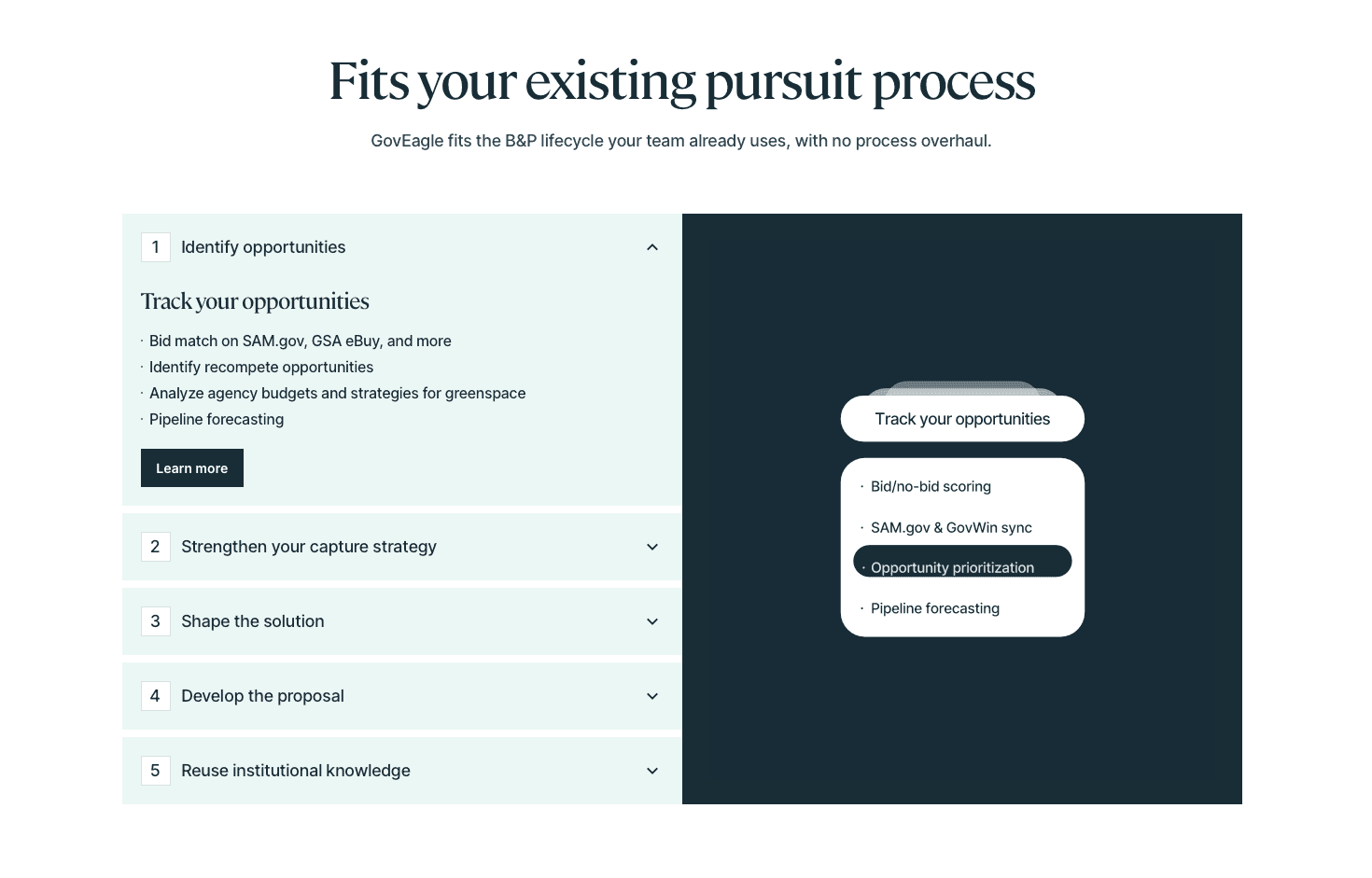
GovEagle is purpose-built for government contractors, which separates it from general-purpose proposal tools that treat federal procurement as an edge case. The product covers the full capture-to-submission workflow: RFP analysis, compliance matrix generation, proposal drafting, and color team review support, all within a single environment that connects to the artifacts your team already works in.
Where many pursuit teams get tripped up is the handoff between capture intelligence and proposal execution. GovEagle keeps those two phases connected. BD teams can track pre-RFP intelligence and feed it directly into the draft, so Section L requirements map to win themes that were built before the solicitation dropped, not reverse-engineered after.
Compliance and Security Posture
Federal proposal tools handling CUI should align with applicable security requirements such as FedRAMP, CMMC Level 2, or NIST 800-171, depending on the environment and contract type. GovEagle is built to that standard, with FedRAMP Moderate Equivalency, CMMC Level 2 alignment, and deployment options that include AWS GovCloud, Azure, self-hosted deployments, and air-gapped environments for SCIF-adjacent work.
What GovEagle Does in Practice
- Parses RFP documents and generates a compliance matrix in Excel, mapped to Section L and Section M requirements, so proposal managers start from a structured baseline instead of a blank grid.
- AI-assisted federal proposal drafting pulls from your past performance library and content repository, producing first drafts that already reflect your firm's voice and prior wins.
- Integrates directly with Microsoft Word, so writers work in the tool they already use without migrating content between systems.
- Supports color team reviews with structured annotation and version control built into the workflow, not bolted on after the fact.
FAQs
How do I choose between GovEagle, GovSignals, pWin.ai, and Loopio for my federal proposal workflow?
Start by identifying where your bottleneck sits. GovSignals and pWin.ai are strongest in the pre-solicitation phase, fitting BD-heavy teams that need pipeline scoring and agency spend analysis before an RFP drops. Loopio fits high-volume teams whose pursuits do not require federal-specific compliance mapping. GovEagle covers the full arc from capture through submission, making it a more practical choice for teams managing concurrent federal pursuits with CUI handling requirements.
Is GovEagle or VisibleThread better for teams that need compliance support earlier in the proposal cycle?
VisibleThread's value concentrates at the review stage, after content is already written. GovEagle generates the compliance matrix from the solicitation before drafting begins, mapping Section L and Section M requirements into a structured Excel output that proposal managers can work from at kickoff, not at Red Team.
Which RFP software tools in this list support CUI handling for teams working on DoD or civilian federal programs?
GovEagle and AskSage are the most clearly documented options for CUI-sensitive environments. GovEagle runs on AWS GovCloud with FedRAMP Moderate Equivalency and supports GCC and GCC High deployments. AskSage supports FedRAMP High and DoD IL5/IL6 environments with a documented path into classified networks. Loopio does not publish FedRAMP alignment. For tools listed as "Not Confirmed" in the feature comparison table, verify security certifications directly with each vendor before committing.
Final Thoughts on RFP Software Built for Federal Proposals
The right RFP software compounds over time: the right tool reduces manual setup on every pursuit, and the wrong one adds friction from kickoff through submission. Fit beats feature count in GovCon tool selection. For teams managing concurrent federal pursuits with CUI handling requirements, GovEagle covers the full arc from capture intelligence through final submission with Excel-native compliance matrix generation, Microsoft Word integration, and FedRAMP Moderate Equivalency.