
SEWP VI Order Guide: Winning IT Services Work

Akash Mandavilli
CEO and Co-Founder of GovEagle
About the author
Akash is a 2x founder with previous experience in AI from Meta and federal sales from IBM. Akash holds a dual-degree from Johns Hopkins University in Economics and Computer Science.
SEWP VI opened NASA's IT vehicle to full IT services work on November 1, 2026. For BD and proposal teams, that means more task orders to triage, and each one sets its own rules: NAICS codes designated per RFQ, set-asides that can narrow a category pool of several hundred to over a thousand holders, and contract types that shape your entire cost narrative. Getting those mechanics wrong is a common way to lose before evaluation even starts.
TLDR:
- SEWP VI ordering is open through October 31, 2036, with Categories B and C now covering full IT services scope previously excluded from SEWP V.
- Your SEWP V contract-holder status does not carry over; confirm your firm appears on NASA's public SEWP VI contract-holder list before pursuing any orders.
- NAICS codes and set-asides are designated at the order level, and SBA checks size against each set-aside order's code. Most IT services codes carry a $34 million size standard, so larger firms usually reach set-aside orders as subcontractors.
- Security requirements beyond the base contracts' supply chain risk management terms are set order by order; assess CUI and FedRAMP obligations during initial triage before scoping a response.
- Services RFQs in Categories B and C default to a 30-day response window, and Category C orders are capped at $2M in year one and $10M in year two.
SEWP VI Category Structure: Products, Services, and Who Fits Where
SEWP VI is composed of approximately 2,116 IDIQ contracts divided across three categories, and which one applies to your firm shapes everything from eligibility to competition pool.
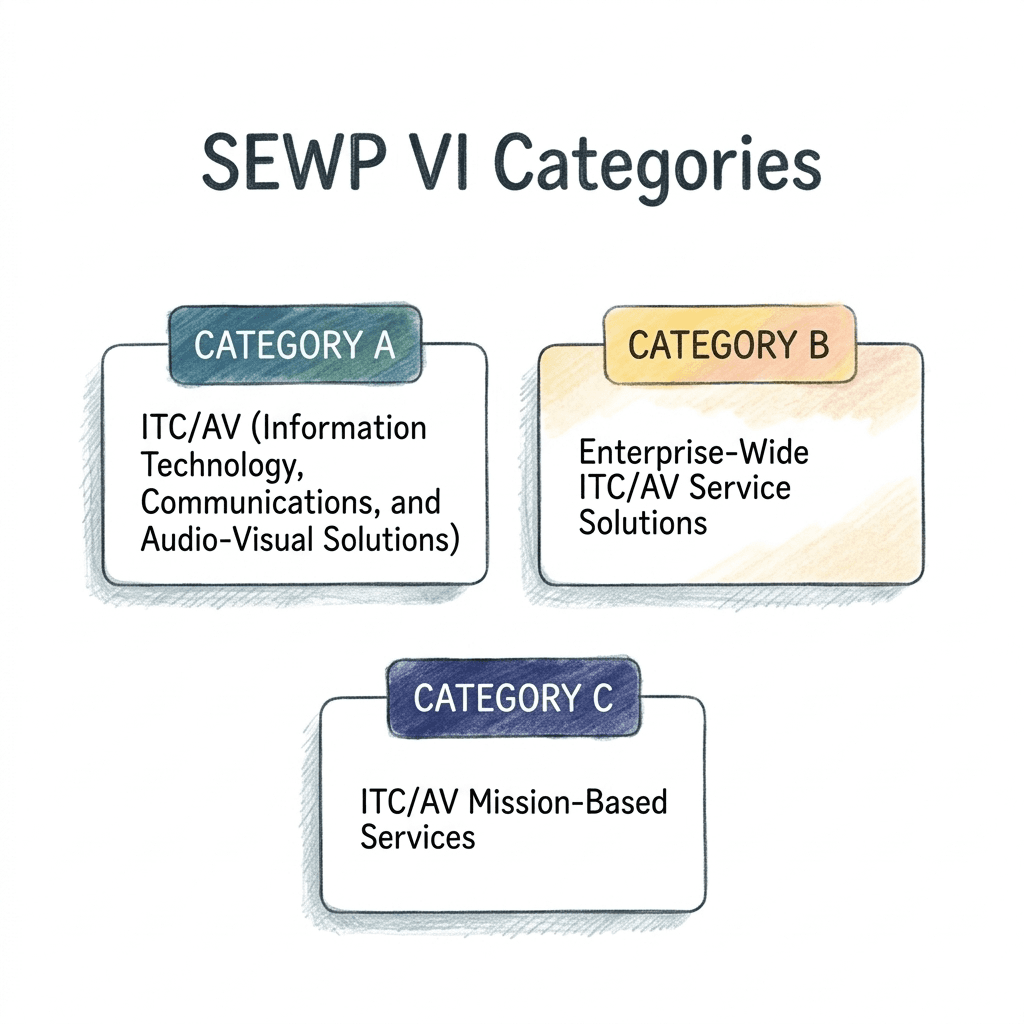
- Category A covers ITC/AV product solutions, open to both large and small businesses.
- Category B covers enterprise-wide ITC/AV service solutions, open to large and small businesses.
- Category C covers mission-based ITC/AV service solutions, restricted to small businesses only. Category C orders are capped at $2M in year one and $10M in year two, with the caps lifted from year three.
Categories B and C overlap in scope by design, but NASA reserves Category B for large-scale, agency-wide work and Category C for mission-level work.
Why Categories B and C Change the Calculus for Services Firms
Under SEWP V and earlier versions, pure IT services work fell outside SEWP's scope (see our NASA SEWP contract guide). Teams pursued managed services, cybersecurity support, and IT service management through other vehicles.
SEWP VI changes that. According to the NASA SEWP V vs. VI comparison, federal agencies that previously could not use SEWP contracts for pure IT services can now use SEWP VI to meet their agency and mission needs.
A services firm with a Category B or C contract now holds a pre-competed, governmentwide path to task orders that previously required a separate vehicle. That shortens acquisition timelines for agencies and expands the addressable market for contract holders.
How SEWP VI Orders Are Found and Answered
Quote requests reach SEWP VI contract holders through the redesigned SEWP Marketplace, which includes the Online Catalog, Strategic Storefronts and BPAs, and a rebuilt Quote Request Tool. Additional features are rolling out during the first year of the vehicle. Current holders request portal access through their company's SEWP Program Manager.
The governing rule is fair opportunity, now at FAR 16.507 under the FAR Overhaul deviations agencies have adopted (NASA's in December 2025), formerly FAR 16.505(b). The Quote Request Tool can send an RFQ to every eligible holder in a category or socioeconomic class, though agencies may solicit fewer firms on orders at or below the simplified acquisition threshold or under a documented exception.
Each category holds hundreds of contracts, and Category C holds over a thousand, so the pool on any RFQ can be deep. A typical response includes pricing, a technical approach tied to the stated requirement, relevant past performance, and any required compliance documentation. Response windows default to five business days in Category A and 30 days in Categories B and C, and agencies can shorten them. Generic boilerplate rarely recovers lost ground against a field that size.
Order-Level Flexibility: NAICS Codes and Set-Asides
Two order-level mechanics matter most for BD teams reviewing incoming quote requests: NAICS code assignment and set-aside eligibility.
Under SEWP V, NAICS codes were fixed at the group level. Per the NASA SEWP Program Office's transition guidance, SEWP VI removes that constraint. NAICS codes are now designated at the order level, using any in-scope code from SEWP's approved NAICS list. Each incoming RFQ carries its own NAICS designation, so capture teams need to assess code alignment on a per-order basis instead of assuming a blanket fit.
Set-asides follow the same logic. All three categories allow any form of small business set-aside at the order level, so agencies can restrict competition to 8(a), SDVOSB, HUBZone, or WOSB holders for a specific order (8(a) and VOSB set-asides are new in SEWP VI). For small business holders, a set-aside narrows the pool considerably, which can shift PWin estimates. For holders that are large under the order's NAICS code, a set-aside order is off the table as prime, so a teaming or subcontract role is worth weighing early (see the next section).
Large Contractors on SEWP VI: Size Checks and Teaming
If your firm averages more than $34 million in annual receipts, it is large under the size standards that cover most SEWP VI services work. SBA's current size standards table sets $34 million for Custom Computer Programming Services (541511), Computer Systems Design Services (541512), and Other Computer Related Services (541519).
Size is checked order by order. When an agency sets aside an order under an unrestricted contract such as Category A or B, SBA measures size for that order as of your offer, against the NAICS code the ordering contracting officer assigns. Standards vary by code: Computer Facilities Management Services (541513) is $37 million and Computing Infrastructure Providers and Data Processing (518210) is $40 million, so a $36 million firm is large under 541512 but small under 541513. Read the code on each RFQ before ruling an order in or out.
If you're large under the order's code, the route to a set-aside order is a subcontract role under a small holder. On set-aside orders above the simplified acquisition threshold, the small prime must comply with FAR 52.219-14, the limitations on subcontracting clause, which SEWP's contracting page calls out. For services, the small prime can't pay more than 50% of what the government pays it to subcontractors that aren't similarly situated, and a large subcontractor isn't. On a $10 million services order, that means at most $5 million can go to all such subcontractors combined, yours included. Scope your share of the work inside that limit.
The split protects the prime's eligibility too. SBA can find a large subcontractor to be an ostensible subcontractor if it performs the primary and vital requirements of an order or the prime is unusually reliant on it, and the small prime is then ineligible for that order. SBA's rules treat the prime as performing the primary and vital work when it and any small subcontractors will meet the limitations on subcontracting.
Size standards may change. In August 2026, SBA proposed new size standards that would make more IT services firms small. Comments close November 20, 2026, and the current standards apply until a final rule takes effect. Before that date, check whether your firm would be small under the proposed standards and decide whether to comment.
Permitted Contract Types and What They Mean for IT Services Teams
Per the NASA SEWP Program Office, SEWP VI permits six named contract types at the order level, plus hybrids of commercial types: Firm Fixed Price, Time and Material, Labor Hour, Fixed Price Award Fee, Fixed Price Incentive Fee, and Fixed Price Economic Price Adjustment. Only Firm Fixed Price was available under SEWP V.
For IT services teams, Time and Material and Labor Hour structures are common choices for staff augmentation, managed services, and professional services work. T&M orders price labor at fixed hourly rates with materials reimbursed at cost; Labor Hour orders follow the same structure without the materials component. Both allow agencies to scope work without fully defining deliverables upfront, which fits ongoing IT support and advisory engagements better than a deliverable-based FFP structure. Agencies still need a written determination that no other contract type is suitable before using T&M or Labor Hour.
Contract type selection also shapes how you build the cost volume. An FFP response requires a fully defined price tied to a deliverable, while a T&M or LH response is built around labor category mix, loaded rates, and a ceiling, mechanics worth revisiting in a broader cost volume guide. Price in the SEWP fee too: per the SEWP VI FAQ, the 0.34% surcharge is included in quoted prices rather than listed separately, and the contract holder pays it. Agencies reviewing quotes expect your cost narrative to match the contract type they specified, so a mismatch raises immediate evaluation risk.
Get GovCon capture and proposal insights in your inbox.
SEWP VI vs. SEWP V: What Changed
The table below captures the structural shift across both vehicles, drawn from the NASA SEWP Program Office transition guidance.
| Area | SEWP V | SEWP VI |
|---|---|---|
| Scope | ITC/AV products + product-related services | ITC/AV products + full suite of IT services |
| Categories | Groups A, B1, B2, C, D | Categories A, B, C |
| NAICS Codes | Fixed per group (334111 / 541519) | Defined at order level; any valid in-scope code |
| Set-Asides | SB, SDVOSB, HUBZone, WOSB, EDWOSB | Any type at the order level, all three categories (adds 8(a) and VOSB) |
| Contract Types | FFP only | FFP, T&M, LH, FPAF, FPIF, FPEPA, and hybrids |
| Services Firms | Product-related services only | Full IT services (Categories B and C) |
| Ordering Period | Closes January 31, 2027 | November 1, 2026 through October 31, 2036 |
Both vehicles run concurrently through January 31, 2027, giving agencies flexibility during the transition window, a timeline worth tracking on any capture manager's pursuit calendar. After that date, SEWP V closes to new orders, though modifications on existing SEWP V orders remain permitted for an additional five years.
A SEWP V seat does not carry over automatically, so confirm your SEWP VI status before quoting.
Confirming Your Contract-Holder Status Before Pursuing Orders
Check NASA's public SEWP VI contract-holder list by category and confirm your firm and its new SEWP VI contract number appear there. NASA can add holders through on-ramps announced on SAM.gov, so any static third-party list may already be outdated. The SEWP VI site is the authoritative source. SEWP VI also adds a dormant status for contract holders, so check what triggers it in the program's current rules.
Treat this as a pre-pursuit checklist item. A status gap uncovered after you have already invested time scoping a response creates avoidable downstream problems.
How to Build a Competitive Quote Response Under SEWP VI
Under SEWP VI, agencies issue quote requests through the Quote Request Tool, and a single category can hold hundreds of eligible holders. Response windows vary by order and can be shorter than the 30-day default for services.
Parsing order-level requirements is the first step. Read the statement of work alongside any agency-specific instructions embedded in the RFQ. These instructions work like Section L, and skipping them is a common way to lose before evaluation begins. Build a compliance matrix against them before writing any technical narrative; our Excel compliance matrix guide shows one format.
For T&M or Labor Hour orders, labor category alignment drives the cost narrative. Map each stated requirement to the labor categories and loaded rates on your contract, then confirm the mix is defensible against the scope. Agencies reviewing T&M quotes expect category selections to reflect the actual work, not a generic seniority tier chosen for margin.
Past performance selection deserves more time than most teams give it. With a pool this large, a relevant, tightly scoped reference does more work than three loosely related ones. Tie each reference explicitly back to a requirement in the SOW.
Proposal software built for federal task orders can cut the time from RFQ receipt to a first draft ready for compliance review, so the team starts from structure instead of a blank page.
Security and CUI Handling on SEWP VI Orders
Security requirements beyond the base contracts' supply chain risk management terms are set order by order on SEWP VI. Agencies issuing task orders through Categories B or C can attach security overlays that go beyond SEWP VI's baseline contract terms.
For orders involving CUI, the tools your team uses to draft and store proposal content may fall inside the assessment boundary. For DoD orders that include DFARS 252.204-7012, contractors must ensure any cloud service that stores, processes, or transmits covered defense information meets security requirements equivalent to the FedRAMP Moderate baseline; civilian requirements vary with contract terms and data flows. NIST SP 800-171 applies through the order's CUI clauses, so check each order's terms, not the vehicle's.
The practical implication is that security assessment belongs at bid/no-bid, not at submission. An order-level security overlay found after you have committed time to a response creates real exposure: either your toolchain is out of scope for that order, or you need to rebuild the response workflow mid-pursuit.
Review the RFQ's security requirements section alongside the SOW during initial triage. If the order references a specific data handling standard, a government cloud enclave, or a CUI processing restriction, treat that as a qualifying criterion before scoping the response. NASA has said CMMC will be added as a verifiable option in the Quote Request Tool.
How GovEagle Supports SEWP VI Pursuit Teams
Services RFQs default to 30 days, but agencies can shorten that, and the same proposal team may be triaging other RFQs and bids at the same time. Hours spent pulling requirements are hours not spent on solution and price.
GovEagle is FedRAMP Certified (Moderate) and built for federal pursuit work. It generates a compliance matrix in Excel from the RFQ's SOW and ordering instructions, quoting each requirement word for word with its source. Its proposal tools then build an annotated outline and draft sections in Word from your content library, so the team starts from structure instead of a blank page. Before you commit, GovEagle's bid/no-bid analysis checks certifications, contract type, capability fit, the incumbent and competitors, and red flags, then gives a pursue recommendation.
Precise Software, a federal IT contractor, cut SME time on early-stage proposals by 80% and reduced overall proposal development time by at least 50% after adopting GovEagle. Chevo, a federal Mission Support Services contractor working against 2 to 5 day turnarounds on RFIs, tracked 30 to 40% time savings on RFIs and 15 to 25% on RFPs and was fully operational within a week. Book a Demo to see how it handles an RFQ.
For teams managing concurrent pursuits, GovEagle's capture management software stores win themes on each opportunity, and the agent draws on them when it drafts, so what you learn in triage carries into the response.
Final Thoughts on the SEWP VI Opportunity for Government IT Contractors
Holding a SEWP VI contract puts you in a large, competitive pool, and the order-level mechanics mean your eligibility and fit need to be confirmed fresh on every RFQ that comes through the portal. The firms that do well here build response discipline early, confirm their contract-holder status before pursuing, and get to a compliant structure fast once an RFQ lands. Order-by-order rules and deep category pools do not favor teams that start from a blank page. The pursuit discipline that makes the difference starts well before submission.
FAQ
How do I build a compliant quote response for a SEWP VI task order on a short response window?
Start by parsing the RFQ's statement of work and any agency-specific ordering instructions as a compliance structure before writing any technical narrative; these instructions work like Section L, and skipping them is a common way to lose before evaluation begins. For T&M or Labor Hour orders, map stated requirements to your labor categories and loaded rates first, then select past performance references tied explicitly to SOW requirements instead of general scope. Services RFQs default to 30 days, but agencies can shorten that. Proposal automation tools that build a compliance matrix in Excel and an annotated outline in Word from the RFQ can cut the time from RFQ receipt to a first draft ready for compliance review.
SEWP VI Categories B and C vs. SEWP V for IT services firms: what actually changed?
Under SEWP V, pure IT services engagements fell outside scope for most contract holders, who had to pursue managed services, cybersecurity support, and IT service management through separate vehicles. SEWP VI Categories B and C change that by opening a pre-competed, governmentwide path to full IT services task orders, with NAICS codes now designated at the order level and small business set-asides of any type permitted per order. Within Category C, which is already limited to small businesses, an 8(a), SDVOSB, HUBZone, or WOSB set-aside can narrow the field further.
What SEWP VI contract types apply to staff augmentation and managed services orders?
Time and Material and Labor Hour structures are common contract types for staff augmentation, managed services, and IT professional services work under SEWP VI. T&M orders price labor at fixed hourly rates with materials reimbursed at cost; Labor Hour orders follow the same structure without the materials component. Agencies reviewing these quotes expect your cost narrative (labor category mix, loaded rates, and ceiling) to match the contract type they specified, so a mismatch creates immediate evaluation risk.
How do I confirm my firm holds a SEWP VI contract before responding to quote requests?
Check NASA's public SEWP VI contract-holder list by category and confirm your firm appears there; a SEWP V seat does not carry over automatically to SEWP VI. NASA can add holders through on-ramps announced on SAM.gov, so any static third-party list of SEWP VI awardees may already be outdated. Treat this verification as a pre-pursuit checklist item, since a status gap uncovered after you have invested time scoping a response creates avoidable downstream problems.
When should security and CUI requirements factor into a SEWP VI bid/no-bid decision?
Security assessment belongs at bid/no-bid, not at submission. Order-level security overlays on SEWP VI Categories B and C orders can go beyond the vehicle's baseline contract terms, and finding a CUI processing restriction or government cloud enclave requirement after you have committed to a response can force a late no-bid or a rebuilt workflow mid-pursuit. For DoD orders that include DFARS 252.204-7012, cloud services that handle covered defense information must meet security requirements equivalent to the FedRAMP Moderate baseline; civilian requirements vary with contract terms and data flows. Review the RFQ's security requirements section alongside the SOW during initial triage and treat any data handling standard or CUI restriction as a qualifying criterion before scoping the response.
Can a large business compete for set-aside SEWP VI orders?
Not as prime if it is large under the order's NAICS code. For a set-aside order under Category A or B, SBA measures size as of your offer on that order, against the NAICS code the contracting officer assigns; the current standard for Computer Systems Design Services (541512) is $34 million in average annual receipts. The main route is a subcontract role under a small holder, within the 50% limitation on subcontracting for services.