
Build a Proposal Management Plan: Shipley-Aligned Template (2026)

Akash Mandavilli
CEO and Co-Founder of GovEagle
About the author
Akash is a 2x founder with previous experience in AI from Meta and federal sales from IBM. Akash holds a dual-degree from Johns Hopkins University in Economics and Computer Science.

GovEagle is not affiliated with, sponsored by, certified by, or otherwise associated with Shipley Associates.
Capture intelligence that never reaches the proposal manager at kickoff gets rebuilt from scratch under deadline pressure. That's a frequent reason a proposal management plan (PMP) starts weaker than the pursuit actually is. The Shipley framework gives you a structure to prevent that, and what follows is a practical template for building a PMP that reflects the work your team already did before the RFP hit.
TLDR:
- A practical Shipley-aligned PMP links 6 working components: compliance matrix, annotated outline, RACI, schedule, amendment tracking, and production checklist.
- Build your proposal schedule backward from submission, with Pink Team at days 10-12 and Red Team at days 20-22 on a 30-day pursuit.
- Capture handoff must transfer win themes, black hat findings, and price-to-win (PTW) position before kickoff, not during it.
- The compliance matrix is one of the first artifacts built after RFP release; a gap caught there is quick to route, while the same gap found at Red Team can pull SMEs back into finished sections.
- GovEagle parses Sections L and M into an Excel compliance matrix and a Word annotated outline before section assignments begin.
Get GovCon capture and proposal insights in your inbox.
What a Proposal Management Plan Is in the Shipley Framework
A Proposal Management Plan is the execution control document for a single federal pursuit. It converts an RFP deadline into a working schedule with assigned ownership across content, compliance, pricing, and color team reviews. Every contributor knows what they are responsible for and when.
Where a generic project plan tracks tasks, a Shipley-aligned PMP is structured around the pursuit itself: Section L instructions drive the outline and its order, Section M criteria shape where content carries the most weight, and the schedule works backward from submission. The PMP is the execution layer that makes Shipley work on a specific opportunity, not a methodology summary.
The Role of the Proposal Manager in Shipley
The proposal manager owns the PMP but rarely writes the proposal's content. That distinction matters more than most teams acknowledge.
In Shipley-aligned pursuit execution, the proposal manager's job is process ownership: holding the schedule, coordinating SME inputs, enforcing compliance gates, and keeping color team reviews on track. When that role collapses into content production, the schedule slips and compliance gaps accumulate unnoticed. The content production role belongs to writers and SMEs; when the proposal manager fills both seats, neither gets done well.
The proposal manager is accountable for:
- Maintaining the master schedule and driving section owners to deadlines
- Coordinating SME availability before the RFP drops, not after
- Enforcing draft thresholds for each color team gate
- Tracking compliance matrix coverage as writing progresses
How Capture Handoff Feeds the Proposal Management Plan
Capture intelligence that never reaches the proposal manager is a planning problem, and a deeper one than a communication gap alone. Win themes developed over months of pre-RFP engagement, competitive positioning from black hat analysis, PTW findings that shaped pricing assumptions: all of it has to transfer formally before kickoff, or the proposal management plan gets built on a weaker foundation than the team actually has.
In a September 2026 Federal News Network commentary, Chris Crowder noted that average win rates for government contracting organizations fell this year for the first time since the pandemic, ending five years of steady increases, while procurement slowed and competition tightened. In that environment, a PMP that reflects strong capture work is a competitive asset. One built from scratch at RFP release is a liability.
The capture handoff should transfer at minimum:
- Confirmed win themes and discriminators developed during pre-RFP engagement
- Black hat assessments for key competitors, including positioning gaps the proposal can exploit
- PTW position and any pricing constraints it surfaces for the cost volume
- Customer relationships and known evaluation preferences that shape Section M weighting
- Open risks or intelligence gaps the proposal team needs to actively track through color reviews
If capture work is thin before kickoff, GovEagle's black hat review profiles likely competitors and the incumbent, and its price-to-win analysis produces a target price with every figure sourced, so two of those inputs arrive with evidence behind them.
The Proposal Kickoff Meeting
The kickoff meeting is where the PMP stops being a proposal manager's document and becomes the team's working agreement. Every contributor leaves with an assignment, a deadline, and enough context to understand why their section matters to evaluators.
A structured kickoff agenda covers five items:
- RFP walkthrough: Section L instructions, Section M criteria, and any non-standard requirements that will shape the compliance matrix
- Compliance plan overview: how requirements will be tracked, who owns the matrix, and what draft thresholds trigger each color team gate
- Win theme alignment: capture handoff translated into section-level messaging that writers can apply
- Role assignments: section ownership confirmed, SME availability locked to the schedule
- Schedule review: submission date worked backward through color team gates, with buffer identified before it's needed
Kickoffs that drift into strategy debates or open-ended RFP interpretation typically signal that capture handoff was incomplete. When win themes need to be developed at kickoff instead of confirmed, the capture-to-proposal gap is already creating a timeline problem.
Core Components of a Shipley-Aligned Proposal Management Plan
Six working components form a practical Shipley-aligned PMP, and each one feeds the next. Shipley's own proposal manager playbook also covers items like writers' packets, strategies and themes, and a draft executive summary; the six below are the controls that tie the schedule together. The compliance matrix, built from Sections L and M, drives the annotated outline. The outline drives section assignments in the RACI. The RACI populates the schedule. The schedule fixes the date of each color team gate. And the amendment tracking protocol keeps all of it current if the solicitation changes before submission.
| Component | What It Does | Depends On |
|---|---|---|
| Compliance matrix | Maps every Section L/M requirement to a proposal section | RFP release |
| Annotated outline | Structures the proposal around compliance coverage | Compliance matrix |
| RACI chart | Assigns ownership for each section and review | Annotated outline |
| Proposal schedule | Sets drafting deadlines and color team gates | RACI assignments |
| Amendment tracking | Flags solicitation changes and routes updates | Active schedule |
| Final production checklist | Confirms submission-ready compliance before upload | Color team sign-off |
A PMP missing any of these components creates a gap the others cannot cover. Without amendment tracking, a schedule stays accurate until it isn't. Without a production checklist, color team sign-off doesn't mean submission readiness.
Building the Proposal Schedule: From RFP Release to Submission
The schedule works backward from submission, not forward from RFP release. That sequencing principle prevents a common failure mode: treating color team reviews as floating milestones instead of fixed gates with hard draft thresholds.
One workable layout for a standard 30-day proposal:
- Pink Team review at days 10-12, covering storyboards, mockups, or early draft sections (often 30-40% complete), when structural compliance problems are still fixable without rewriting finished sections
- Red Team at days 20-22 (80-90% draft complete), inheriting a draft that has already cleared structural review
- Gold Team at days 26-27 (final draft, leadership sign-off)
- Production and final compliance check at days 28-29
These draft percentages are common practice, not Shipley rules, so set your own thresholds in the PMP. Buffer belongs before each gate, not after. A Red Team that runs long has nowhere to go if production starts the next morning. The two inputs that most often break compressed schedules are SME deliverables arriving late and Pink Team cut to save time, which simply defers structural problems to Red Team when there is far less room to recover.
If the solicitation calls for an oral presentation, put it in the PMP too: name the orals team, schedule rehearsals, and plan a final murder board before the government's orals date, which often falls after the written proposal is submitted.
The Compliance Matrix as the Foundation of the PMP
The compliance matrix is one of the first artifacts a proposal team produces after RFP release, and every subsequent planning decision traces back to it. Section L instructions tell writers how to structure each volume. Section M criteria tell reviewers how evaluators will score what writers produce. A matrix that captures both, mapped to specific response sections, gives the entire team a shared reference that holds through Gold Team.
A well-built compliance matrix includes four columns at minimum: requirement source (L or M, with paragraph reference), the response section where it is handled, the assigned owner, and current status. Our compliance matrix guide covers a fuller seven-column version. That structure lets the proposal manager track coverage at a glance without re-reading the RFP to confirm a requirement was covered.
In Deltek's 2026 Clarity GovCon study, contractors reported spending an average of 84 hours developing a single proposal, so late rework comes out of a tight budget. A requirement caught during matrix build is quick to route. The same gap caught at Red Team can take hours to fix, often pulling SMEs back into sections they already reviewed and approved. GovEagle generates a compliance matrix in Excel from Sections L and M and the PWS or SOW, quoting each requirement word for word with its source, so the team starts from the full requirement list instead of building it by hand. To see that workflow run on a real RFP, Book a Demo.
The matrix connects directly to the annotated outline: each Section L requirement maps to a proposal section, and the outline inherits that structure. During color team reviews, the matrix becomes the evaluative lens. Pink Team checks structural compliance against it; Red Team verifies that every mapped requirement has substantive coverage, beyond a placeholder.
Annotated Proposal Outline: Bridging Compliance to Writing
The compliance matrix tells you what must be covered. The annotated outline tells writers where and how to handle it, section by section, before a single word of draft content exists.
Each section inherits its structure directly from Section L: volume, subsection, page or word limit, and the specific instructions writers must follow. Section M criteria get layered in alongside them, so writers can see how each subsection will be scored before they start. That dual mapping keeps the draft aligned to both instructions and scoring criteria from the first sentence, before Red Team surfaces any disconnect.
The outline's practical value is what it pre-loads. Before writers open a blank document, relevant past performance references, reusable boilerplate, and capture-sourced win themes can be attached to each section as part of a proposal storyboard structure, which compresses the time from kickoff to a reviewable Pink Team draft.
Color Team Review Integration in the PMP
Running structured pink, red, and gold team reviews functions as a quality control only when the gates are fixed to draft thresholds and staffed in advance. A Pink Team listed on a schedule but not resourced is a placeholder, not a gate.
Each gate carries a defined entry condition:
- Pink Team (storyboards, mockups, or early draft): checks compliance against Section L and execution of the win strategy, and confirms the annotated outline held through early drafting.
- Red Team review (80-90% draft): scores substantive coverage against Section M criteria, treating the compliance matrix as the scoring lens.
- Gold Team review (final draft): leadership sign-off on strategy, risk, and submission readiness.
- Green Team (where applicable): pricing review and cost story alignment with the technical approach.
- Final production check (often called White Glove): page limits, formatting, and required attachments confirmed before upload.
On a full Part 15 pursuit, compressing Pink and Red into a single mid-cycle review is a common schedule failure. Structural problems and coverage gaps surface together with too little time to fix either without pulling writers off other sections. The PMP should treat each gate as a hard entry condition, not a flexible checkpoint that slips when SME inputs run late.
Review findings must route back into the compliance matrix. A Red Team finding that a Section M criterion lacks substantive coverage is a matrix status update tracked as open until a writer closes it. Gold Team sign-off means the matrix shows full coverage, not merely that leadership reviewed the executive summary.
Roles and Responsibilities: RACI Structure for Proposal Teams
A RACI matrix in the proposal management plan removes ambiguity about who decides versus who delivers. Without it, SMEs get pulled into approvals they shouldn't own, and volume leads wait on sign-off from people who assumed someone else was reviewing.
Standard roles across a federal proposal effort:
- Proposal Manager: Accountable for schedule, compliance tracking, and gate enforcement
- Capture Manager: Responsible for win theme inputs and competitive guidance during drafting
- Volume Leads: Responsible for section-level content; Accountable for their volume's draft quality
- SMEs: Responsible for technical inputs; Consulted on approach, not on compliance decisions
- Pricing Lead: Responsible for cost volume; Informed on technical approach assumptions that affect pricing
- Contracts: Consulted on terms, representations, and certifications
- Color Team Reviewers: Informed of draft thresholds; Responsible for findings only within their assigned gate
A frequent RACI mistake is listing SMEs as Accountable for sections they are only Consulted on. That misclassification pulls them into review loops and approval chains that belong to volume leads, creating the bottleneck that slips Pink Team deliverables.
Scaling the PMP to Proposal Complexity and Team Size
Not every pursuit warrants a 40-page PMP. A full FAR Part 15 competitive proposal with five volumes and a 60-day response window needs the complete structure: compliance matrix, annotated outline, RACI, gated color team schedule, amendment tracking, and production checklist. A GSA Schedule RFQ or IDIQ task order response with a 10-page technical volume and a 5-day turnaround needs a lighter version, but never zero structure.
On small pursuits, three components keep their full weight even as the rest get lighter:
- A compliance matrix, even a one-page version mapping each requirement to an owner
- A schedule with at least one structured review gate before submission
- Role assignments that confirm who has final accountability for each section
What scales down on smaller pursuits is formality, not discipline. A lean team responding to a short-deadline task order can run a single combined Pink/Red review in place of two separate gates, provided the draft is substantive enough to review. What they cannot skip is checking the compliance matrix against the final draft before upload.
Team size shapes the RACI more than it shapes the schedule. A two-person pursuit team still needs someone accountable for compliance and someone accountable for content. Without that split, both slip.
Proposal Management Plan Template and Checklist
| PMP Component | Owner | Status |
|---|---|---|
| Pursuit summary (opportunity name, NAICS, set-aside, submission deadline, estimated contract value) | Proposal Manager | Complete before kickoff |
| Capture handoff documentation (win themes, black hat findings, PTW position, known customer relationships) | Capture Manager | Complete before kickoff |
| Compliance matrix (Section L/M requirements mapped to response sections, with paragraph references) | Proposal Manager | Complete within 48 hours of RFP release |
| Proposal schedule (color team gates, SME deadlines, production window, buffer periods) | Proposal Manager | Published at kickoff |
| RACI assignments (section owners, SME consultations, reviewer roster for each gate) | Proposal Manager | Confirmed at kickoff |
| Annotated outline (Section L structure with Section M criteria layered per subsection) | Proposal Manager (skeleton), Volume Leads (annotations) | Skeleton before kickoff; annotations complete before Pink Team |
| Amendment tracking log (amendment number, release date, affected sections, update status) | Proposal Manager | Active through submission |
| Final production checklist (compliance matrix at 100%, page limits verified, required attachments confirmed, submission system tested) | Proposal Manager | Complete after Gold Team sign-off, before upload |
Run through each row before submission. The checklist earns its place when it catches a missing representation or a page-limit overrun before the upload window opens, not as a post-mortem artifact.
How GovEagle Supports Shipley-Aligned Proposal Management Plans
Shared vocabulary closes the communication problem a Shipley-aligned PMP describes. It does not close the workflow problem: capture intelligence sitting in CRM notes, compliance gaps surfacing at Red Team, and annotated outlines built manually from scratch after every RFP release. GovEagle's CRM integrations with Salesforce and HubSpot bring capture notes and opportunity data into the proposal workspace before kickoff.
GovEagle parses Sections L and M directly into an Excel compliance matrix and generates an annotated proposal outline in Microsoft Word before writers begin drafting. Those are two of the most time-consuming artifacts to build correctly, and they are ready before a single section is assigned. The capture handoff, RACI, and schedule then build on a foundation already mapped to the RFP, with assumptions and anomalies flagged for the team to confirm.
Customer results show what that time back looks like. According to Chevo's GovEagle case study, Chevo cut proposal prep time 30 to 40 percent on RFIs and 15 to 25 percent on RFPs, with full team adoption in one week. The Integrity Defense Solutions case study reports 3 to 4 times faster proposal preparation for a lean defense team. Precise Software, a federal IT contractor, cut SME time on early-stage proposals by 80% with GovEagle, which freed senior leaders to focus on strategy rather than research.
For the color team gates the PMP schedules, GovEagle's proposal review supports Pink, Red, and Gold Team reviews and can use your compliance matrix as the requirements source, rating each requirement's coverage so reviewers are not left reconstructing it from memory. GovEagle is FedRAMP Certified (Moderate) through its partnership with Knox Systems, giving IT and security reviewers a recognized federal baseline to start from.
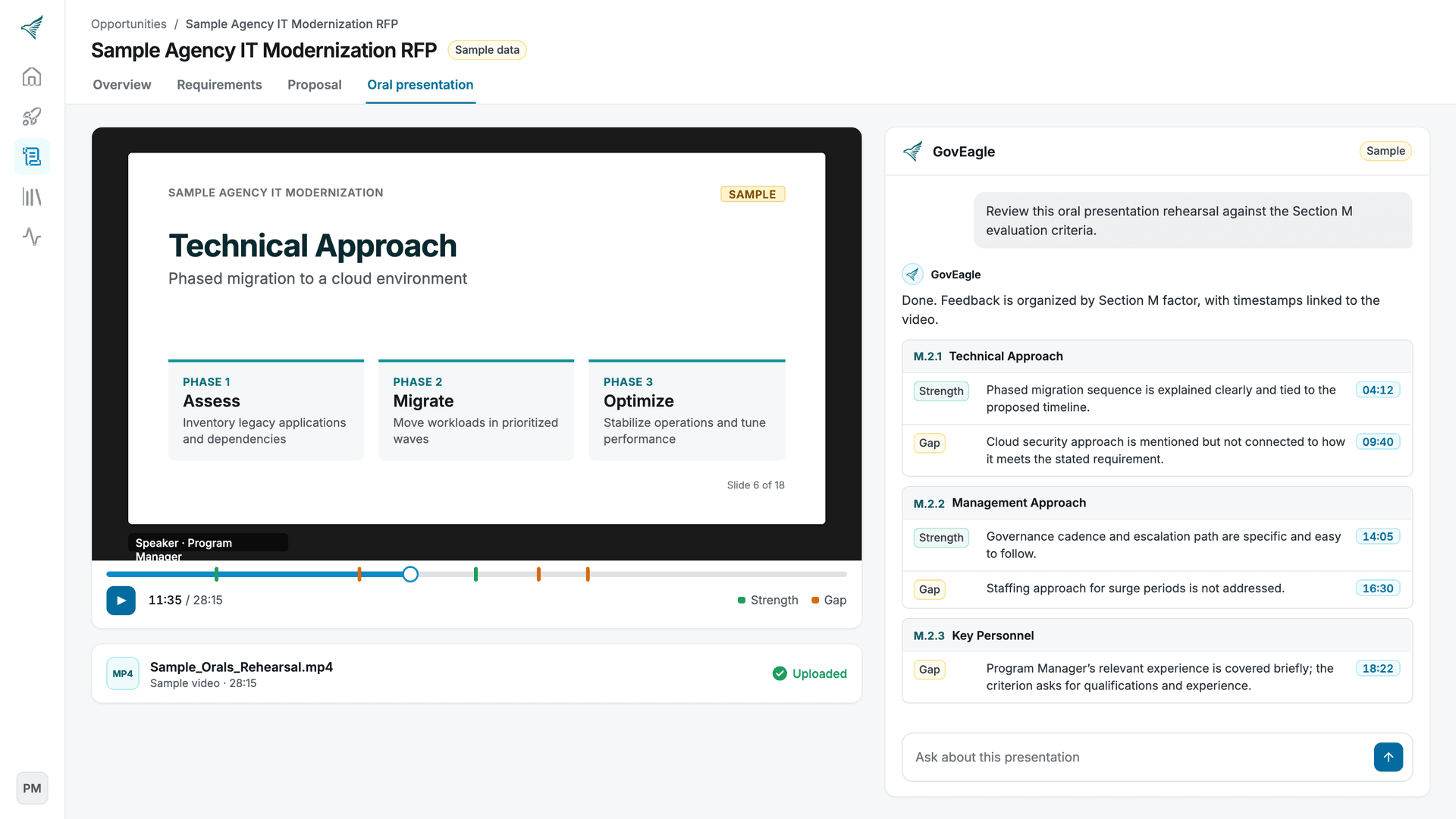
For orals prep, teams can upload rehearsal recordings to GovEagle, up to 30 minutes each. GovEagle produces a timestamped transcript, splits each recording into titled moments, and for video reads what's on screen as well as what's said. Reviewers can then ask questions about the run-through and get answers with timestamp citations that play the recording from that point.
Final Thoughts on Shipley Proposal Management Plan Execution
A well-built PMP doesn't make proposal development easier in a vague sense; it makes the specific decisions that break pursuits harder to miss. Capture intelligence transfers before kickoff. Compliance gaps surface at Pink Team, not Red Team. SME accountability is written into the RACI before anyone asks who owns a section. Your next pursuit doesn't need a longer response window; it needs better infrastructure at the start. Talk to GovEagle to see how it fits your workflow, and enter every pursuit with the structural foundation already in place, from RFP parsing and compliance matrix generation to color team review support.
FAQ
How do I build an annotated proposal outline from an RFP before my writers start drafting?
Start with the compliance matrix: extract every Section L instruction and Section M criterion, map each to a specific proposal section, and assign paragraph references. The annotated outline inherits that structure directly, so each subsection arrives pre-loaded with its required instructions, evaluation criteria, page limits, and any capture-sourced win themes or reusable past performance references before a writer opens a blank document. GovEagle generates both artifacts (the compliance matrix in Excel and the annotated outline in Microsoft Word) from the RFP before section assignments are made, with each section's requirements and page limits cited to the RFP. Writers then add win themes and past performance, and GovEagle can search your content library for relevant past proposal content.
What should a Shipley proposal management plan include at minimum for a FAR Part 15 competitive pursuit?
A practical Shipley-aligned PMP links six components: a compliance matrix built from Sections L and M, an annotated outline structured around that matrix, a RACI chart assigning section ownership and SME consultation roles, a backward-scheduled color team gate sequence, an amendment tracking log active through submission, and a final production checklist confirmed after Gold Team sign-off and before upload. Pursuit size can reduce the formality of each component, but none can be dropped entirely: a missing amendment log leaves the schedule accurate until a solicitation change makes it wrong, and a missing production checklist means color team sign-off does not equal submission readiness.
GovEagle vs. manual Shipley PMP execution for federal proposal teams?
Manual Shipley execution works when capture intelligence transfers cleanly, the compliance matrix gets built correctly from Sections L and M, and color team gates hold their draft thresholds. Those three conditions break down most often when teams are under deadline pressure, which is when the PMP matters most. GovEagle takes on the most time-consuming part: it parses Sections L and M into an Excel compliance matrix and generates an annotated Word outline before drafting begins, so the compliance infrastructure is in place at kickoff, not assembled under deadline.
Can I run Shipley color team reviews without rebuilding the compliance matrix at each gate?
Yes, provided the compliance matrix was built correctly at RFP release and stays current through drafting. Each gate uses the same matrix as its evaluative lens: Pink Team checks structural compliance against Section L, Red Team verifies substantive coverage against Section M criteria, and Gold Team sign-off means the matrix shows full coverage, not merely that leadership reviewed the executive summary. Red Team findings that identify a Section M criterion without substantive coverage should be logged as open matrix items and tracked until a writer closes them, so the matrix reflects actual proposal status and not review-round history.
How does capture handoff feed into a Shipley proposal management plan?
Capture intelligence (confirmed win themes, black hat assessments, price-to-win position, and known evaluation preferences) must transfer formally to the proposal manager before kickoff, or the PMP gets built on a weaker foundation than the pursuit actually has. At minimum, the handoff should include win themes developed during pre-RFP engagement, competitive positioning gaps the proposal can exploit, PTW constraints that shape the cost volume, and open intelligence gaps the proposal team needs to track through color reviews. If your team works in Salesforce or HubSpot, GovEagle's CRM integrations bring capture notes and opportunity data into the proposal workspace, so the handoff starts from the pursuit record instead of memory.
Does GovEagle help with oral presentations?
Yes, for rehearsal review. Teams upload rehearsal recordings to GovEagle, up to 30 minutes each. GovEagle produces a timestamped transcript, splits each recording into titled moments, and for video reads what's on screen as well as what's said. Reviewers can then ask questions about the run-through and get answers with timestamp citations that play the recording from that point. The orals team, rehearsal dates, and a final murder board still belong in the PMP schedule, ahead of the government's orals date, which often falls after the written proposal is submitted.