
Federal RFP, RFQ, and RFI: Key Differences (September 2026)

Akash Mandavilli
CEO and Co-Founder of GovEagle
About the author
Akash is a 2x founder with previous experience in AI from Meta and federal sales from IBM. Akash holds a dual-degree from Johns Hopkins University in Economics and Computer Science.
GovEagle is not affiliated with, sponsored by, certified by, or otherwise associated with Shipley Associates.
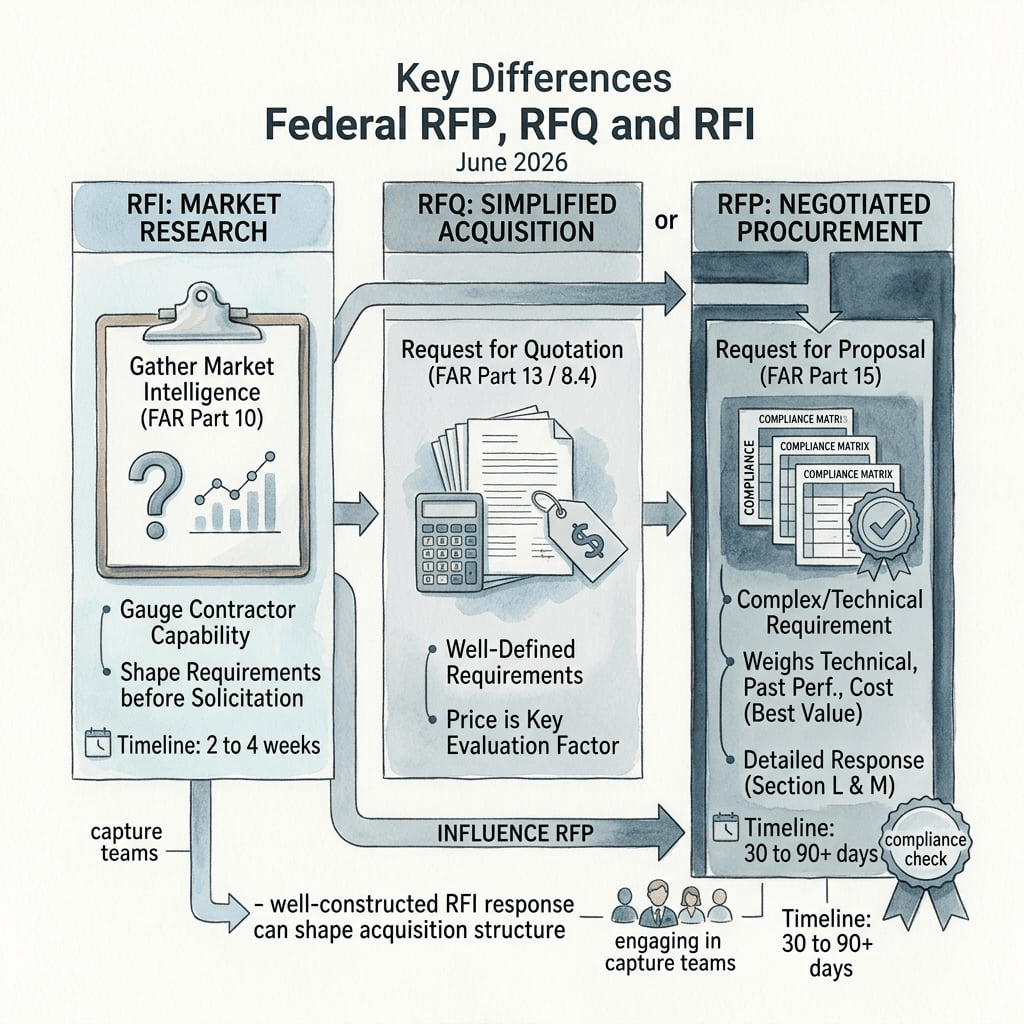
You track solicitations by acronym: RFP, RFQ, RFI. But the label is not the strategy. What separates them is timing, scope certainty, and evaluation weight. The RFP vs RFQ vs RFI difference determines when you need to engage, what the response requires, and whether you still have room to influence the outcome. Most capture teams wait for the RFP and find themselves responding to criteria that were shaped during the RFI stage by firms that showed up earlier. What follows is a guide to when to use RFP RFQ RFI, what each one signals about the acquisition lifecycle, and where positioning happens before any solicitation is published.
TLDR:
- RFIs gather market intelligence before a solicitation exists; RFQs generally request pricing for defined requirements; RFPs weigh technical approach, past performance, and cost under FAR Part 15.
- A well-constructed RFI response can shape acquisition structure and evaluation criteria before the RFP drops.
- RFQs appear under FAR Part 13 (simplified acquisitions at or below the current simplified acquisition threshold) and on GSA Schedules via FAR Subpart 8.4 for orders above that threshold.
- RFP responses scored against Section M criteria often fail when teams miss Section C requirements not restated in Section L.
- Proposal automation tools can generate compliance matrices and map Section L requirements to response sections across RFI, RFQ, and RFP workflows.
What RFI, RFQ, and RFP Mean in Federal Procurement
Federal procurement uses three request types, each tied to a different stage of acquisition:
- A Request for Information (RFI) is a market research tool. Agencies issue RFIs before a solicitation exists to gather industry input on capabilities, pricing, and acquisition approaches. Responses carry no contractual weight.
- A Request for Quotation (RFQ) applies when the requirement is well-defined and pricing carries weight, usually for commercial items as defined under FAR Part 12 or simplified acquisitions under FAR Part 13.
- A Request for Proposal (RFP) is the formal solicitation used when source selection involves technical evaluation. Responses answer Section L instructions and Section M criteria, and award weighs factors beyond price alone.
How Federal Agencies Use RFIs for Market Research
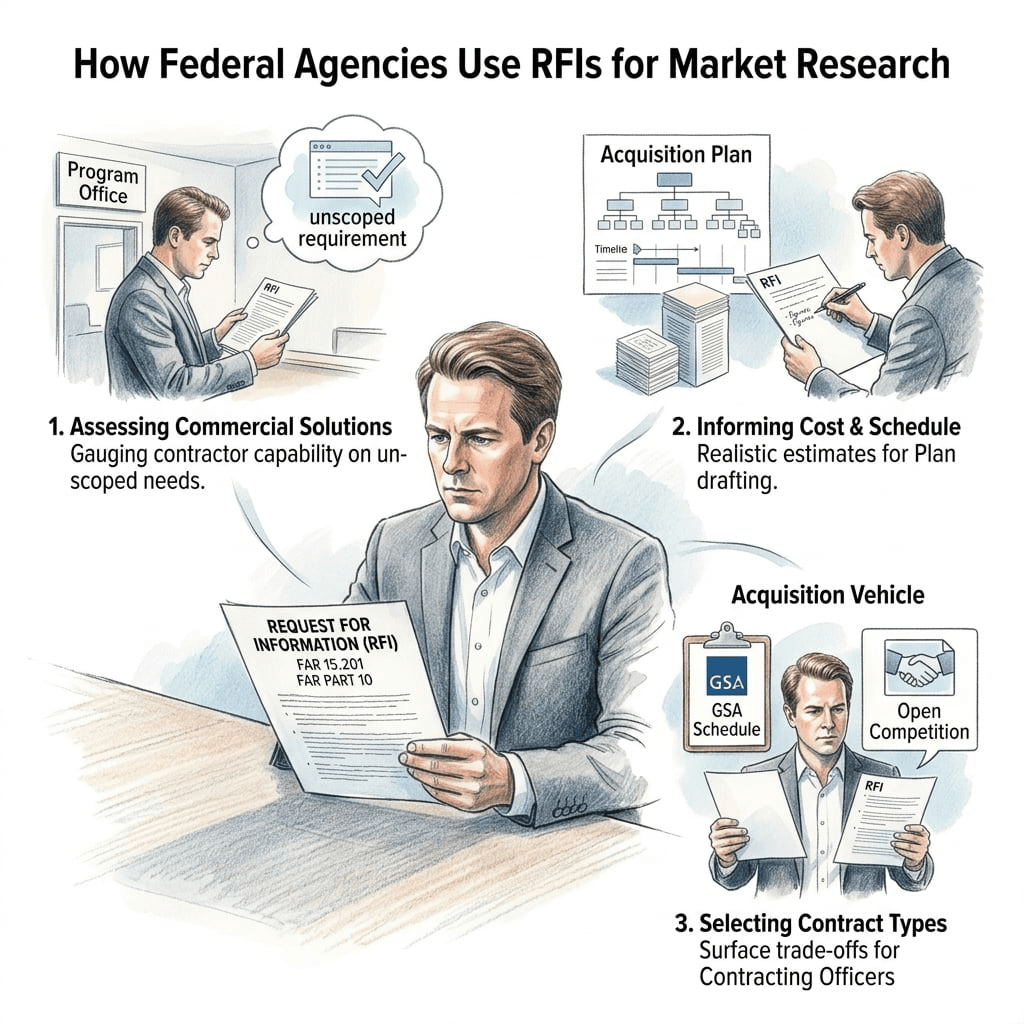
Agencies issue an RFI under FAR 15.201 when they need market intelligence before committing to a procurement strategy, within the broader FAR Part 10 market research framework.
- When a program office is assessing whether commercial solutions exist for a requirement not yet scoped, an RFI gauges contractor capability without opening a competition prematurely.
- When an agency wants realistic cost ranges, periods of performance, or teaming structures before drafting an acquisition plan, RFI responses can inform those estimates.
- When contracting officers are choosing between acquisition vehicles or contract types, RFI feedback can surface acquisition trade-offs internal market research may not identify.
What Agencies Typically Ask in an RFI
RFI content varies by program, but agencies commonly ask vendors to describe past performance, identify small business teaming arrangements, flag regulatory or technical constraints, and comment on draft requirements or Performance Work Statements still in progress.
Many capture teams treat RFI responses as low-stakes outreach, but a well-constructed response can shape acquisition structure, influence evaluation criteria, and build credibility with the program office before a solicitation drops. It is one of the few pre-solicitation levers that shapes the eventual RFP.
When Agencies Issue RFQs Under Simplified Acquisition Procedures
At or below the simplified acquisition threshold (SAT), currently $350,000, agencies often use simplified acquisition procedures instead of a negotiated RFP process. Contracting officers issue RFQs under FAR Part 13 for faster, less formal purchasing without the documentation that governs larger buys.
Where RFQs Also Appear Above the SAT
On existing vehicles like GSA Schedules, agencies regularly issue RFQs to place task orders against pre-negotiated pricing, even above the simplified acquisition threshold.
The RFQ still functions as a competitive quotation process within a structured framework. Vendors have already competed for schedule placement, so the agency selects among pre-vetted sources instead of running an open competition. FAR Subpart 8.4 governs these orders and sets thresholds and fair opportunity requirements.
How RFPs Work Under FAR Part 15 Negotiated Procurement
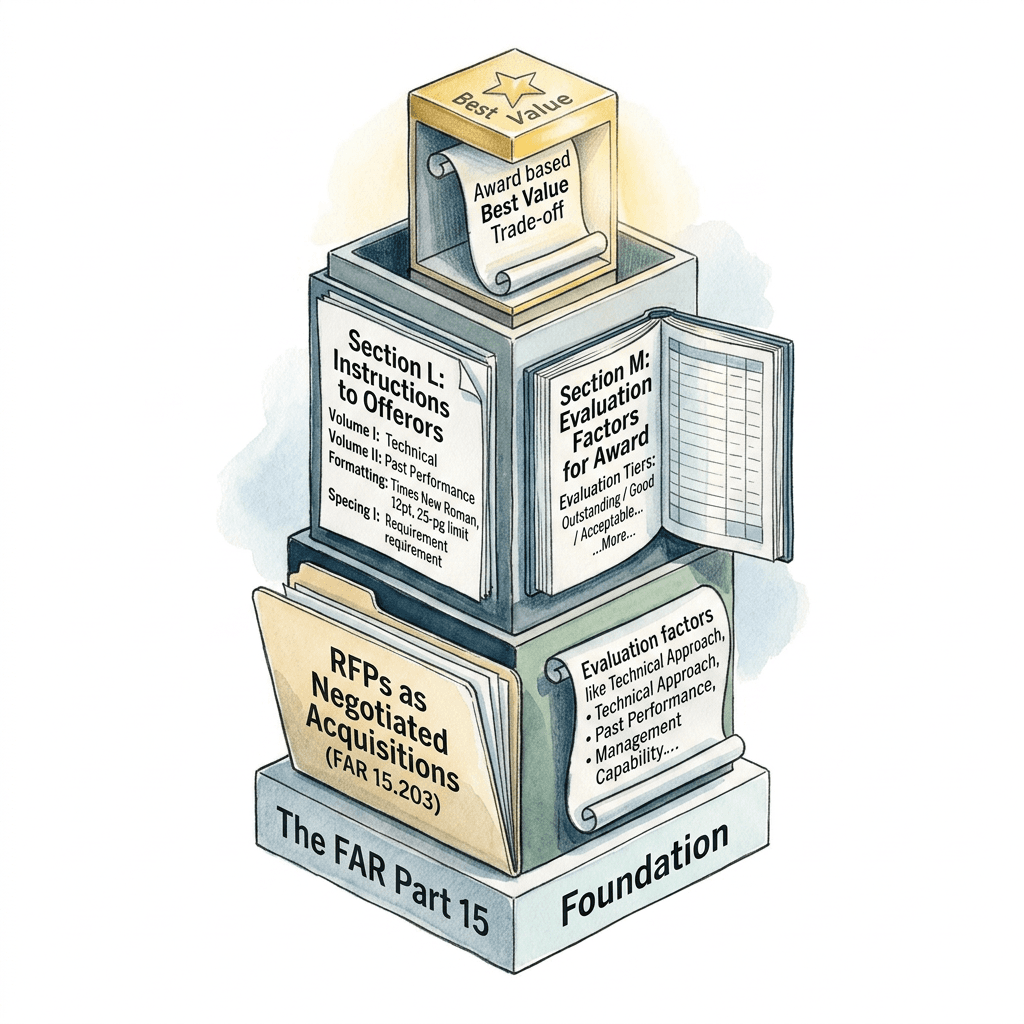
Under FAR Part 15, the RFP is the government's primary vehicle for negotiated acquisitions where price alone won't decide award. Agencies release one when they weigh technical approach, past performance, and management capability alongside cost.
The package typically includes Section L (instructions to offerors) and Section M (evaluation criteria), which together define how proposals are scored. Offerors who miss either section risk a technically unacceptable rating regardless of price.
What the FAR Part 15 Process Looks Like in Practice
- Section L spells out volume requirements, page limits, and formatting rules. Deviations from these instructions can get a proposal eliminated before evaluation begins.
- Section M defines the evaluation factors and their relative weights. Teams that build win themes around Section M language tend to score better, because evaluators score against the stated criteria, not inferred needs.
- The competitive range determination happens after initial evaluation. Offerors outside that range are excluded from discussions.
- Final proposal revisions (FPRs) follow government discussions. Teams that treat discussions as a formality and return minimal revisions leave evaluation points on the table.
Response Requirements and Compliance Obligations for Each Solicitation Type
RFP Response Requirements
RFPs typically require the most extensive responses, often spanning technical, management, past performance, and price volumes. Agencies score proposals under FAR Part 15 source selection procedures, meaning each volume maps directly to evaluation criteria in Section M. The friction is mapping Section L requirements to response sections while keeping traceability to Section M scoring criteria.
RFQ Response Requirements
RFQs under FAR 8.4 or 13 generally request pricing and enough technical information and past performance details for the agency to quote. The bar is lower, but price competitiveness carries weight, since some task orders may focus lowest-priced technically acceptable selection, depending on the RFQ and ordering procedures.
RFI Response Requirements
RFIs carry no formal compliance burden. Responses are voluntary and non-binding, but contractors who skip them miss the chance to shape requirements before a solicitation is written.
When the Government Uses Each Vehicle: Decision Factors and Thresholds
An RFQ fits lower-complexity, FAR Part 12 commercial-item requirements where price decides and the statement of work is well-defined. An RFP comes into play when the requirement is complex or technically uncertain, or when past performance and management approach carry evaluation weight alongside price.
Key Decision Factors
Three variables drive vehicle selection:
- Requirement complexity: FAR Part 12 commercial items move through an RFQ; technically complex requirements call for the full RFP process under FAR Part 15.
- Evaluation criteria: an LPTA award or simple price quote often fits an RFQ; best-value tradeoffs call for an RFP.
- Market knowledge: when a program office is unsure what solutions exist or what a realistic period of performance looks like, an RFI gathers that intelligence without triggering procurement obligations.
At the pre-RFP stage, draft PWS language, market research notices, or prior history on USASpending.gov often signal which vehicle is coming, shaping how aggressively a team invests in pre-award positioning. Firms that spot an RFI window early can shape requirements before drafting begins; those facing a fast-turn RFQ must focus on pricing and contracting-office relationships.
How to Position Your Firm During the Pre-Solicitation Phase
Pre-solicitation positioning is where many pursuit teams lose ground. The document type signals where the agency sits in the acquisition lifecycle, and reading it correctly shapes how your firm engages.
When an agency releases an RFI, it is still defining the requirement. That window is your chance to shape scope, surface your contract experience and technical capabilities, and build credibility with the program office before requirements are finalized. Firms that treat RFI responses as throwaway submissions often end up reacting to an RFP written around a competitor's approach.
Reading the Signal, Beyond the Document
Each pre-solicitation instrument carries a different implication for capture timing:
- An RFI with detailed technical questions often means the agency is further along than the formal acquisition phase suggests, and a draft PWS or SOW may already exist internally.
- An RFQ issued under simplified acquisition procedures signals a faster procurement cycle with less room for competitive differentiation, making prior relationship-building with the contracting office more consequential.
- A pre-RFP industry day tied to an upcoming RFP gives your BD team a chance to get questions on record that can steer clarifying amendments in your favor.
Firms that convert pre-solicitation intelligence into earlier bid/no-bid decisions build more disciplined pipelines. Capture leads who wait for the RFP to assess fit work from a structural disadvantage no proposal quality can overcome.
Typical Timeline Differences Between RFI, RFQ, and RFP Processes
RFIs move fastest, usually two to four weeks, though early-stage research can run longer. RFQs follow a compressed schedule, with response windows often falling in the ten-to-thirty-day range under simplified acquisition procedures. RFPs carry the longest timelines: competitive acquisitions under FAR Part 15 commonly allow thirty to ninety days, sometimes more for complex procurements.
How Timeline Awareness Shapes Pursuit Decisions
Capture teams that treat solicitation release as the starting gun fall behind, since pre-RFP engagement, teaming, and past-performance positioning all happen before the clock starts. Recognizing which document type is coming gives teams a realistic window to judge bandwidth and whether the bid/no-bid call should happen earlier.
| Document | Typical Response Window | Governing Framework |
|---|---|---|
| RFI | 2 to 4 weeks | FAR Part 10 (Market Research) |
| RFQ | 10 to 30 days | FAR Part 13 (Simplified Acquisition) |
| RFP | 30 to 90+ days | FAR Part 15 (Contracting by Negotiation) |
How GovEagle Supports Responses Across RFI, RFQ, and RFP Solicitations

Whether a solicitation arrives as an RFI, RFQ, or RFP, the workflow challenge is the same: capture teams need to move fast, stay compliant, and produce responses that hold up under evaluator scrutiny.
GovEagle supports that workflow across all three solicitation types. For RFIs, teams can draft capability statements and RFI responses without starting from scratch. For RFQs, GovEagle helps organize pricing structures and technical proposal narratives against stated requirements. For full RFPs, the system generates compliance matrices, maps Section L requirements to response sections, and keeps the entire effort traceable from solicitation to submission.
The practical result is that BD and proposal teams spend less time on proposal organization and compliance preparation, and more time on what moves the needle with evaluators.
FAQs
What's the difference between an RFI, RFQ, and RFP in federal procurement?
An RFI is a market research tool used before any solicitation exists. An RFQ applies when the requirement is well-defined and pricing is a primary evaluation factor. An RFP is the formal solicitation under FAR Part 15, requiring full proposals scored against Section L and Section M.
Can an agency issue an RFQ for requirements above the simplified acquisition threshold?
Yes. Many RFQs under FAR Part 13 fall at or below the simplified acquisition threshold, but agencies also issue RFQs for task orders on vehicles like GSA Schedules above that threshold. FAR Subpart 8.4 governs those procedures, with fair opportunity requirements based on order value.
When does the government use an RFP instead of an RFQ?
Agencies use an RFP under FAR Part 15 when source selection scores technical approach, past performance, and management capability alongside price, or when best-value tradeoffs apply. RFQs fit straightforward commercial items where the statement of work is well-defined and price decides the award.
Final Thoughts on Federal Solicitation Strategy
The RFP, RFQ, RFI difference comes down to what an agency already knows, what it still needs to decide, and how much room you have to shape the outcome. RFIs appear when the requirement is still forming, RFQs when the agency knows what it wants and needs competitive pricing, and RFPs when the evaluation weighs technical approach and past performance alongside cost. Teams that wait for the RFP are reacting to requirements competitors may have shaped months earlier. GovEagle puts that reading into practice: GovEagle supports all three solicitation types with compliance scaffolding that adapts to whatever vehicle the agency issues.