
Federal Contracting Trends 2026-2031: Seven Major Shifts

Akash Mandavilli
CEO and Co-Founder of GovEagle
About the author
Akash is a 2x founder with previous experience in AI from Meta and federal sales from IBM. Akash holds a dual-degree from Johns Hopkins University in Economics and Computer Science.
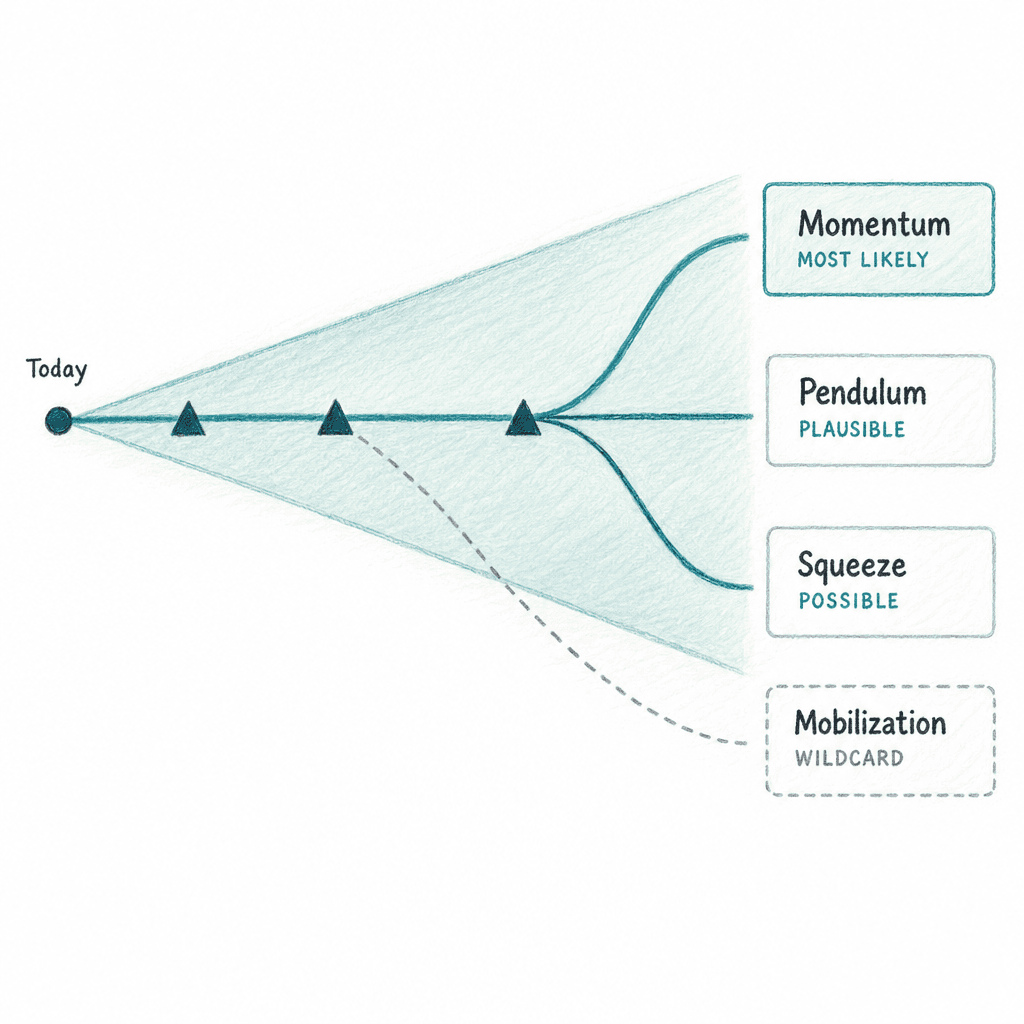
Contract obligations hit a record, fewer firms shared them, civilian spending dipped, and the terms of the buy, contract type, format, and who counts as small, are changing at the same time. GovEagle's Federal Contracting Outlook 2026-2031 lays out the evidence, ratings, and scenarios behind seven findings and four possible futures. The sections below give capture and proposal teams the practical read on each finding in order.
TLDR:
- The market is splitting into two: about $491B of FY2025 contract obligations went through defense agencies and about $301B through civilian agencies, and civilian advisory recompetes may buy less
- The number of small businesses winning prime contract dollars fell 39% from FY2013 to FY2025, even as SBA's proposal would redefine "small" upward
- EO 14402 makes fixed-price contracting the default, and about $262B of FY2025 contract dollars went through non-fixed-price contracts, so pricing volumes built around CPFF or T&M structures need review now
- Buying is concentrating into fewer, bigger vehicles such as SEWP VI and OASIS+, where missing the initial competition can mean years outside
- Neo-primes, rules in permanent motion, and AI on both sides of the table round out the seven findings behind this outlook
The Structural Reality of the 2026-2031 Federal Market
In FY2025, the latest full year of contract data, federal agencies obligated about $793 billion through contracts, up $17.8 billion from FY2024 after adjusting for inflation. About $491 billion went through defense agencies and about $301 billion through civilian agencies, per GAO's FY2025 contracting snapshot.
For contractors, the rules governing how agencies buy, what they buy, and who qualifies to sell are all in flux at once. The FAR is being rewritten piece by piece. The fixed-price default has changed the risk calculus on cost volumes. SBA has proposed replacing nearly 1,000 size standards with 338. And agencies are writing AI into their contract terms.
1. Two markets: defense surges while civilian contracting stalls
Defense agencies now take the larger share of federal contract obligations, and the FY2027 budget request may widen that gap further. How wide the split gets is still uncertain, and Finding 1 of the outlook lays out the evidence behind it.
For capture teams, competition for cleared and engineering staff may get tighter as civilian-focused firms move toward defense work, and civilian advisory recompetes may come back smaller: narrower scopes, fewer staff, and lower ceilings than the expiring contract carried. Large Department of War awards nearing the end of their period of performance are research leads for a possible recompete, follow-on, or extension. GovEagle's Federal Recompete Outlook lists federal contracts nearing end of performance, with dollar figures that reflect obligations to date, not contract ceilings.
According to GAO, the department operated under continuing resolutions in all but 12 of the last 49 fiscal years, and the current continuing resolution, Public Law 119-103, funds agencies through December 11, 2026. New starts typically wait for full-year appropriations, which can compress awards into a later surge, so building continuing resolution strategy into pipeline management matters for how capture teams time qualification work.
The report names the budget and spending signals that will show how wide the split gets. See the defense and civilian split in the five-year outlook for the full finding.
2. Fewer small firms, while “small” is being redefined upward
The number of small businesses winning prime contract dollars fell 39% from FY2013 to FY2025. On August 20, 2026, the SBA proposed new size standards for 338 industries, replacing nearly 1,000 current standards and raising the limits sharply.
For a small business capture lead, the practical worry is a set-aside pool suddenly crowded with competitors many times larger than today's typical small business. Firms that grew out of small business status could regain set-aside eligibility, including mid-size firms well above today's limits. Teaming arrangements built around specific size designations may need restructuring before any final rule takes effect.
Early public comments have been mostly negative, and the comment period was extended by 60 days. Keep tracking the definition of small business changes as the rule moves toward final form.
The five-year outlook ties the proposal to the shrinking small-business base, laying out what it could mean for set-aside strategy and which rulemaking and vendor-count signals will confirm this shift.
3. Risk moves to the contractor
On April 30, 2026, the President signed Executive Order 14402, making fixed price the default procurement method across executive branch agencies. Non-fixed-price contracts remain permitted, but the contracting officer must justify each one in writing. Above set dollar values, the agency head, or a senior official the agency head delegates to, must approve it in writing: $100 million at the Department of War, $35 million at NASA, $25 million at DHS and $10 million at other agencies. Research and development contracts, and pre-production development for major systems, are exempt from the approval rule. Approval must come before the solicitation for RFPs issued on or after July 15, 2026, and existing contracts with 18 or more months left should have an approved justification by July 15, 2027.
In FY2025, about a third of federal contract dollars went through non-fixed-price contracts. Under fixed price, the margin committed at award is the margin you execute against, so basis-of-estimate accuracy, labor category mapping, and risk reserve calculations carry more weight than they did under cost-type structures. For teams whose cost volume workflow was built around CPFF or T&M, the inputs and risk framing need to change before the RFP drops. Fixed price only works when the requirements are defined well enough to price, so where a PWS is vague, raise it before the question deadline.
For proposal teams, a vague scope can now draw fewer bids at higher prices, since firms price that uncertainty in to protect their margin, so flagging ambiguous requirements early matters more under a fixed-price default. Finding 3 of the outlook lays out the supporting evidence and the signposts worth watching in more depth.
4. Fewer, bigger doors
Federal buying is consolidating into large government-wide acquisition contracts, other multiple-award vehicles and enterprise deals, and only seat holders can compete for orders on them. The Army's $50 billion MAPS services vehicle merged two sets of contracts into one, a pattern that fits what the five-year outlook calls fewer, bigger doors: for a capture planner, an on-ramp may not come for years, so the initial competition is the one to plan for.
SEWP VI ordering opened November 1, 2026 and runs through October 31, 2036 as a single 10-year ordering period. Category A covers IT products, while Categories B and C add a full suite of IT services, a major scope change from SEWP V's products-heavy model. NAICS codes are designated at the order level, and small business set-asides of any type are permitted at the order level across all three categories.
A SEWP V seat does not carry over automatically under the NASA SEWP contract structure, and SEWP V is scheduled to stop taking new orders on January 31, 2027, so firms that haven't confirmed their SEWP VI contract-holder status should check their access now. NASA's contract allows future on-ramps, but none has been announced. OASIS+ Phase II is the exception to the closed-door pattern: since January 12, 2026, GSA has kept all six OASIS+ solicitations open to new proposals until further notice, with awards made on a rolling basis, and says it will give advance public notice before closing any domain.
The five-year outlook maps how vehicle consolidation closes doors and lays out what would reopen or further narrow them.
5. Neo-primes: the money is ahead of the market share
Venture-backed defense startups, often called neo-primes, draw outsized attention relative to their current share of federal spending. Per the five-year outlook, these firms still receive only a small slice of Pentagon dollars going to defense firms.
The outlook expects a bumpy few years for these firms, with slow production orders and falling valuations, before a bigger role in the market by 2031. Other transaction agreements are a common entry path for this segment; see GovEagle's guide to OTA awards and task orders. For traditional contractors, this may show up as teaming offers from nontraditional firms and often as new competition on prototype work.
Signposts worth tracking include the nontraditional share of Department of War obligations, the volume of production OTAs, and the first defense-tech IPOs. The five-year outlook details the neo-prime funding gap behind this shift.
Get GovCon capture and proposal insights in your inbox.
6. Rules in permanent motion
The FAR Overhaul, launched under Executive Order 14275, is already in effect at agencies that adopted the FAR Council's model deviations, which began in 2025. The FAR Council published eight proposed rules, four on June 23 and four on September 18, 2026, covering 36 FAR parts. None is final, and no proposed rule for Part 19 (small business) has been published. Until final rules land, a contractor may hold contracts under the original FAR and under agency deviations at the same time. For a running account of what has changed and what is still pending, see GovEagle's post tracking the FAR Overhaul.
For proposal teams, at agencies using the Part 15 deviation, contracting officers should use the Uniform Contract Format but are no longer required to, so solicitations can arrive without Section L and Section M under those labels. The deviation's short-form RFPs are exempt from the format. Competitive RFPs that skip it must still state what goes in the proposal and how it will be judged, wherever that text sits. The September 2026 proposed rule would again direct contracting officers to use the format for written RFPs. Teams whose process starts with parsing Section L into a compliance matrix need to map whatever structure the actual solicitation uses, without assuming the format they have always worked from.
For proposal teams, the practical takeaway is to treat solicitation format and clauses as variable for the foreseeable future, and the report expects the churn to last through at least the 2028 election. See GovEagle's outlook on why the rules stay in motion.
7. AI on both sides of the table
GSA's AI clause, GSAR 552.239-7001 (Basic Safeguarding of Data within Large Language Model Artificial Intelligence Systems), took effect October 19, 2026 for new GSA solicitations and contracts. It applies where a language model is a material feature of what GSA buys and handles government data: contractors must disclose the AI models that process government data, within 120 days of starting work unless the contract sets a date, and follow data-handling, objectivity, and use-rights terms. It excludes contractors' internal business, back-office, and performance-support systems. OMB M-25-22 sets rules for how agencies buy AI.
Agencies are also looking at AI for the proposals they receive. A Transportation Department AI adviser, quoted by GovCIO, said AI is useful for an initial administrative sweep of proposals, such as checking small business status, while technical review stays with people. The Defense Intelligence Agency asked industry about AI for acquisitions covering proposal intake, evaluation workflows, and compliance checks.
For proposal teams: if you sell LLM-based products or services through GSA contracts, including the Schedule, expect the clause in new solicitations. The clause does not directly govern the tools you use to write proposals, but the security of any tool that touches Controlled Unclassified Information (CUI) still matters. Questions about whether agencies can detect AI in a proposal matter less than whether your compliance and past performance details are easy to check.
The five-year outlook rates how soon AI screening may arrive at major civilian buying offices. Proposal teams should keep past performance and compliance details easy to check by a machine reviewer as well as a human one.
Four Possible Federal Markets in FY2031
Several of these forces are still unresolved, so a single forecast is less useful than a set of futures. The five-year outlook follows the market through the next funding fights and the 2028 election, then sketches four futures for FY2031: Momentum, Pendulum, Squeeze and Mobilization. The report rates how likely each one is and what would push the market toward it.
Each future calls for a different BD posture: how far to shift toward defense work, which vehicles to rank first, and how hard to push set-aside positioning before the size rule is final.
The outlook also lists the signposts that will show which future is taking shape, from FY2027 funding and the final SBA size rule to contract-type mix and AI in evaluation. Some have fixed deadlines; others won't be known until after the 2028 election.
What Capture and Proposal Teams Should Do Now
Each finding, and what to do about it now:
Seven Findings: What Each Means for Your Pursuit Team
| Finding | Action Required Now |
|---|---|
| 1. Two Markets | Weigh defense versus civilian mix, track expiring Department of War contracts as research leads, and plan the BD calendar for CR slips |
| 2. Fewer Small Firms | Confirm NAICS positioning and teaming arrangements before a final rule takes effect |
| 3. Risk Moves to the Contractor | Rebuild cost volume workflow around fixed-price assumptions before the next RFP drops |
| 4. Fewer, Bigger Doors | Audit SEWP VI and OASIS+ contract-holder status now; OASIS+ stays open to new proposals until GSA gives notice |
| 5. Neo-Primes | Assess OTA paths and teaming with nontraditional firms |
| 6. Rules in Permanent Motion | Map compliance requirements from the actual solicitation structure, not an assumed format |
| 7. AI on Both Sides | Keep compliance and past performance details easy to check; proposal tools that touch CUI should align with FedRAMP Moderate or equivalent depending on the contract |
How GovEagle Supports Pursuit Execution
GovEagle supports pursuits from opportunity search and bid/no-bid through color team review, carrying capture intelligence into the proposal. Ask GovEagle for a bid/no-bid analysis and it checks the solicitation against past performance in your content library, the incumbent, and likely competitors, then gives a pursue recommendation. Precise Software cut SME time on early-stage proposals by 80% and proposal development time by at least 50%. Integrity Defense Solutions estimates its RFI preparation is 3 to 4 times faster. Chevo, a federal Mission Support Services contractor, cut prep time 30 to 40% on RFIs and 15 to 25% on RFPs.
GovEagle is FedRAMP Certified (Moderate) through its partnership with Knox Systems and can handle CUI.
What to Watch Next
These seven findings point to a market that is splitting between defense and civilian work, concentrating into fewer vehicles, and pushing more pricing risk onto contractors. Several findings are still unresolved, so the useful work now is setting defense mix, vehicle positions and pricing assumptions while watching the signposts. Read the full Federal Contracting Outlook 2026-2031 for the evidence behind each finding, the likelihood ratings for the four futures and the signposts to track. It is free to read online, and the PDF edition collects the same material with links to primary sources. Teams that act on the signposts early may be better positioned to bid once funding and rules settle.
FAQs
What are the biggest growth opportunities in government contracting right now?
Defense is often described as the growing half of the market, with about $491B of FY2025 contract obligations through defense agencies, and cleared and engineering labor may stay in demand there. Vehicles such as SEWP VI, now open with Categories B and C adding IT services, and OASIS+, open to new proposals until GSA gives notice, set who can compete for a meaningful share of that spend. Expiring Department of War contracts are research leads for possible recompetes, and nontraditional defense firms may become teaming partners on OTA work.
How does the FAR Overhaul affect compliance matrix workflows when Section L and Section M no longer appear in every solicitation?
At agencies using the FAR Overhaul's Part 15 deviation, contracting officers are no longer required to use the Uniform Contract Format, so an RFP can arrive without Sections L and M. Competitive RFPs must still state proposal instructions and evaluation factors, but they may appear anywhere in the document. Teams need a process that maps requirements from whatever structure the actual solicitation uses. Where Sections L and M do appear, ask GovEagle to build the compliance matrix and it pulls each requirement word for word from Sections L and M and the PWS or SOW, and can fill your own Excel template.
Should I rebuild my cost volume workflow before the next RFP drops given the fixed-price default, or wait until I see a solicitation that requires it?
Start now. Executive Order 14402, signed April 30, 2026, made fixed-price the default across executive branch agencies. Non-fixed-price contracts now need a written justification, with agency approval above set dollar values, and for solicitations issued on or after July 15, 2026, that approval must come before the solicitation is released. Under fixed-price, the margin you commit at award is the margin you execute against, so basis-of-estimate accuracy, labor category mapping, and risk reserve calculations all carry more consequence than they did under CPFF or T&M structures. Waiting until an RFP drops leaves no runway to recalibrate pricing assumptions before submission.
What does the GSA AI acquisition clause mean for contractors already using AI in proposal development?
GSA's AI clause (GSAR 552.239-7001) applies to GSA contracts for AI tools where the language model is a material feature and handles government data, not to contractors' internal business and back-office systems, so it does not directly govern the tools you use to write proposals. If you sell LLM-based products or services through GSA contracts, expect to disclose the models that process government data and follow the clause's data-handling terms. If a proposal tool touches CUI, security still matters: in DoD contracts that include DFARS 252.204-7012, a contractor that uses a cloud service to store, process or transmit covered defense information must require the provider to meet security requirements equivalent to the FedRAMP Moderate baseline. GovEagle is FedRAMP Certified (Moderate) and can handle CUI.
How do I keep bid/no-bid decisions from backing up when many large contracts reach the end of their period of performance at once?
Move the qualification decision earlier in the capture cycle, before RFP release. Defense-focused firms may face the steepest prioritization problem when every expiring contract looks like a qualified lead and all of them compete for the same capture resources. The practical fix is systematic PWin assessment against pipeline data well ahead of solicitation drop, so capture resources concentrate on pursuits where relationship positioning and pricing intelligence are already in place. Ask GovEagle for a bid/no-bid analysis and it checks the solicitation against past performance in your content library, the incumbent, and likely competitors, then gives a pursue recommendation.